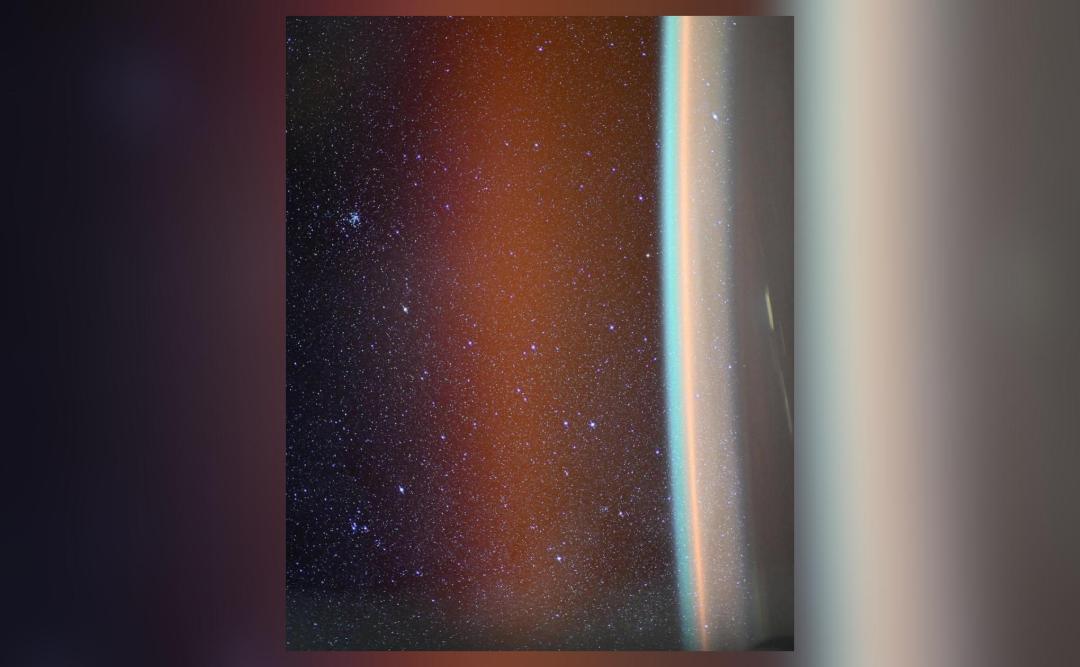
Pic shows colours of Earth’s atmosphere as seen from space
A breathtaking image captured from the International Space Station (ISS) has given us a glimpse of the vibrant colours of Earth’s atmosphere as seen from space. The photograph, which has been making rounds on social media, showcases the stunning beauty of our planet’s atmosphere, with multiple layers of green, orange, and red hues. According to NASA astronaut Don Pettit, the image features “multiple vibrant layers of green atomic oxygen, orange hydroxyl radicals, and red airglow excited from solar activity.”
The phenomenon responsible for this spectacular display is known as airglow. Airglow occurs when atoms and molecules in the upper atmosphere, excited by sunlight, emit light in order to shed their excess energy. This process results in a faint glow that can be seen from space, and it is a common occurrence in the Earth’s atmosphere. However, the vibrant colours and layers visible in this image are a rare treat, and it’s a testament to the incredible beauty of our planet.
The image shows the curvature of the Earth, with the blackness of space in the background. The atmosphere glows with a greenish tint, which is caused by the presence of atomic oxygen. This is the most prominent feature of the image, and it’s a result of the oxygen atoms in the upper atmosphere being excited by solar radiation. As the oxygen atoms return to their ground state, they emit light at a specific wavelength, which gives the atmosphere its greenish hue.
Above the green layer, there is a thin orange layer, which is caused by the presence of hydroxyl radicals. These radicals are formed when ultraviolet radiation from the sun interacts with the atmosphere, breaking down the molecules into their constituent atoms. The hydroxyl radicals then emit light at a specific wavelength, which gives the atmosphere its orange tint.
The red layer on top is caused by airglow excited by solar activity. This is a result of the sun’s radiation interacting with the atmosphere, causing the atoms and molecules to become excited and emit light. The red colour is a result of the longer wavelengths of light being emitted by the excited atoms and molecules, and it’s a common feature of airglow.
The image is not only aesthetically pleasing, but it also provides valuable information about the Earth’s atmosphere. By studying airglow, scientists can gain insights into the composition and temperature of the upper atmosphere, as well as the effects of solar activity on our planet. The image also highlights the importance of the ISS as a platform for scientific research, providing a unique perspective on our planet and its atmosphere.
The ISS has been a vital tool for scientific research, with a wide range of experiments and observations being conducted on board. From studying the effects of microgravity on living organisms to monitoring the Earth’s climate and atmosphere, the ISS has played a crucial role in advancing our understanding of the universe. The image of the Earth’s atmosphere is just one example of the incredible work being done on the ISS, and it’s a reminder of the importance of continued investment in space exploration and scientific research.
In conclusion, the image of the Earth’s atmosphere as seen from space is a breathtaking reminder of the beauty and complexity of our planet. The vibrant colours and layers visible in the image are a result of the intricate processes that occur in the upper atmosphere, and they provide valuable insights into the composition and temperature of our planet. As we continue to explore and study our planet, images like this remind us of the importance of preserving and protecting our planet for future generations.
Source: https://www.instagram.com/p/DRsbl4PEZJx/
About the Author