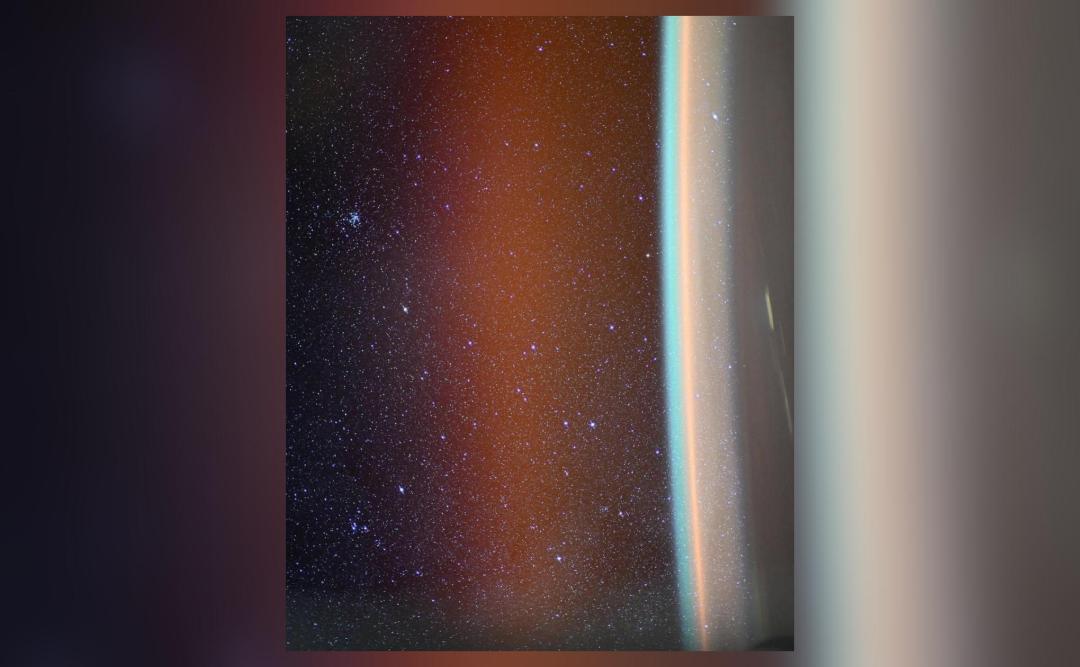
Pic shows colours of Earth’s atmosphere as seen from space
The Earth’s atmosphere is a complex and dynamic system that surrounds our planet, protecting us from the harsh conditions of space. While we are familiar with the blue sky that we see every day, the atmosphere takes on a different appearance when viewed from space. A recent image captured from the International Space Station (ISS) shows the bright colours of the Earth’s atmosphere, a breathtaking sight that reveals the intricate layers of gases that surround our planet.
The image, which was shared by NASA astronaut Don Pettit, shows multiple vibrant layers of green atomic oxygen, orange hydroxyl radicals, and red airglow excited from solar activity. The colours are a result of a phenomenon known as airglow, which occurs when atoms and molecules in the upper atmosphere, excited by sunlight, emit light in order to shed their excess energy. This process creates a spectacular display of colours that can be seen from space, and is a testament to the incredible beauty and complexity of the Earth’s atmosphere.
Airglow is a natural process that occurs in the upper atmosphere, at altitudes of around 100-200 km. At these heights, the atmosphere is thin and the pressure is low, allowing atoms and molecules to exist in a state of excitement for longer periods of time. When sunlight hits these atoms and molecules, it excites them, causing them to vibrate and rotate. As they return to their ground state, they emit light, which we see as airglow.
The colours that we see in the image are a result of the different wavelengths of light that are emitted by the atoms and molecules in the upper atmosphere. Green atomic oxygen, for example, emits light at a wavelength of around 557.7 nanometers, which is why it appears green to our eyes. Orange hydroxyl radicals, on the other hand, emit light at a wavelength of around 656.3 nanometers, which is why they appear orange. The red airglow that is visible in the image is caused by the excitation of oxygen atoms and molecules by solar activity, which emits light at a wavelength of around 630.0 nanometers.
The image captured by NASA astronaut Don Pettit is not only a stunning example of the beauty of the Earth’s atmosphere, but it also provides valuable insights into the complex processes that occur in the upper atmosphere. By studying airglow, scientists can gain a better understanding of the dynamics of the atmosphere, including the movement of atoms and molecules, and the effects of solar activity on the Earth’s magnetic field.
The ISS, from which the image was captured, is a unique platform for studying the Earth’s atmosphere. Orbiting the Earth at an altitude of around 400 km, the ISS provides a perfect vantage point for observing the atmosphere and the effects of solar activity on the planet. The station is equipped with a range of instruments, including cameras, spectrometers, and magnetometers, which allow scientists to study the atmosphere in unprecedented detail.
In addition to its scientific value, the image captured by NASA astronaut Don Pettit is also a reminder of the incredible beauty of the Earth’s atmosphere. The vibrant colours and intricate layers of gases that surround our planet are a testament to the awe-inspiring complexity of the natural world. As we continue to explore and study the Earth’s atmosphere, we are reminded of the importance of protecting this vital system, which supports all life on Earth.
In conclusion, the image captured from the ISS shows the bright colours of the Earth’s atmosphere as seen from space, a breathtaking sight that reveals the intricate layers of gases that surround our planet. The colours are a result of airglow, a natural process that occurs when atoms and molecules in the upper atmosphere, excited by sunlight, emit light in order to shed their excess energy. The image provides valuable insights into the complex processes that occur in the upper atmosphere, and is a reminder of the incredible beauty and importance of the Earth’s atmosphere.
News Source: https://www.instagram.com/p/DRsbl4PEZJx/
About the Author