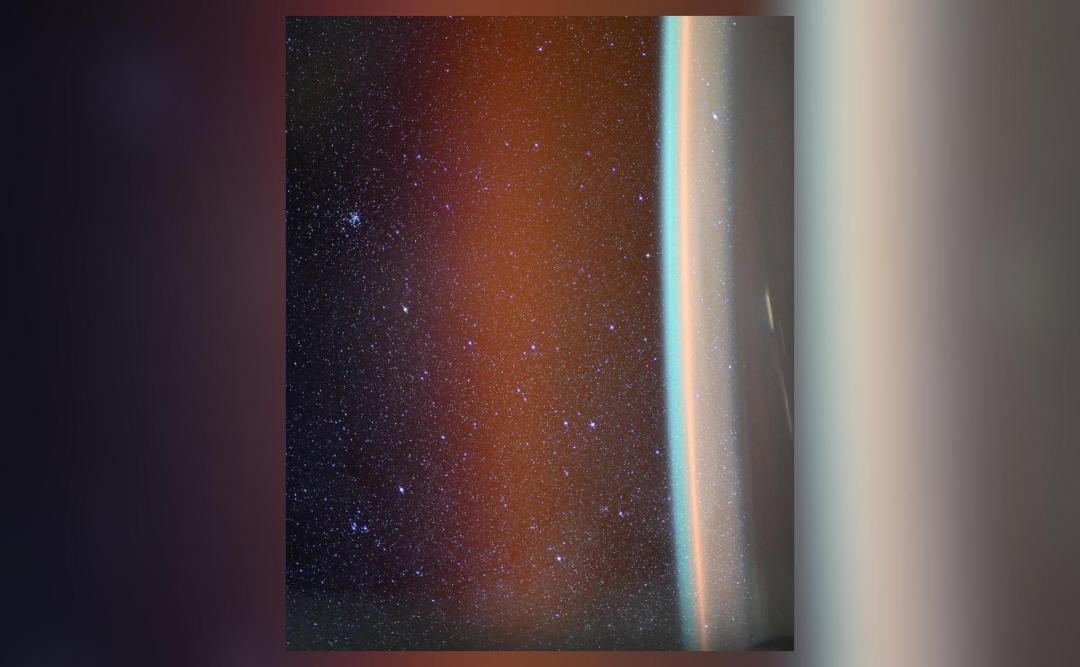
Pic shows colours of Earth’s atmosphere as seen from space
The Earth’s atmosphere is a complex and fascinating layer of gases that surrounds our planet, and when viewed from space, it can display a kaleidoscope of colours. A recent image captured from the International Space Station (ISS) has given us a glimpse into the breathtaking beauty of our atmosphere, showcasing vibrant layers of green, orange, and red hues.
NASA astronaut Don Pettit, who is currently on board the ISS, shared the stunning image on social media, describing it as “Multiple vibrant layers of green atomic oxygen, orange hydroxyl radicals, and red airglow excited from solar activity.” The image has left many in awe, with its swirling patterns of colour that seem to dance across the horizon.
But what exactly are we seeing in this image? To understand the colours on display, we need to delve into the science behind the Earth’s atmosphere. The atmosphere is composed of different layers, each with its own unique characteristics and properties. The layer that is visible in the image is the upper atmosphere, which is home to a variety of atoms and molecules that are excited by sunlight.
When these atoms and molecules absorb energy from the sun, they become excited and start to vibrate. As they return to their ground state, they release this excess energy in the form of light, a phenomenon known as airglow. Airglow is a common occurrence in the upper atmosphere, and it is responsible for the beautiful colours that we see in the image.
The green colour that is visible in the image is due to the presence of atomic oxygen, which is excited by sunlight and emits light at a wavelength of around 557.7 nanometers. This wavelength is responsible for the greenish hue that we see in the image. The orange colour, on the other hand, is due to the presence of hydroxyl radicals, which are molecules composed of one hydrogen atom and one oxygen atom. These molecules are also excited by sunlight and emit light at a wavelength of around 656.3 nanometers, which gives them their orange colour.
The red colour that is visible in the image is due to the presence of airglow excited by solar activity. During periods of high solar activity, the sun emits more ultraviolet radiation, which excites the atoms and molecules in the upper atmosphere, causing them to emit light at longer wavelengths, such as red and orange. This is why we see a reddish hue in the image, particularly around the edges of the atmosphere.
The image captured by NASA astronaut Don Pettit is not only stunning but also provides valuable insights into the Earth’s atmosphere. By studying the colours and patterns of the atmosphere, scientists can gain a better understanding of the complex processes that occur in the upper atmosphere, such as the interaction between the atmosphere and the solar wind.
The image also highlights the importance of the ISS as a platform for scientific research. The ISS provides a unique vantage point for studying the Earth’s atmosphere, allowing scientists to conduct experiments and gather data that would be impossible to obtain from the ground. The ISS has been home to a variety of scientific experiments over the years, including those focused on the Earth’s atmosphere, and has provided valuable insights into the workings of our planet.
In conclusion, the image captured by NASA astronaut Don Pettit is a stunning reminder of the beauty and complexity of the Earth’s atmosphere. The vibrant colours on display are a result of the interaction between the atmosphere and the sun, and provide valuable insights into the processes that occur in the upper atmosphere. As we continue to explore and study our planet, images like this one remind us of the awe-inspiring beauty of the Earth and the importance of continued scientific research and exploration.
Source: https://www.instagram.com/p/DRsbl4PEZJx/
About the Author