Largest Solar Storm in Over 20 Years Hits Earth
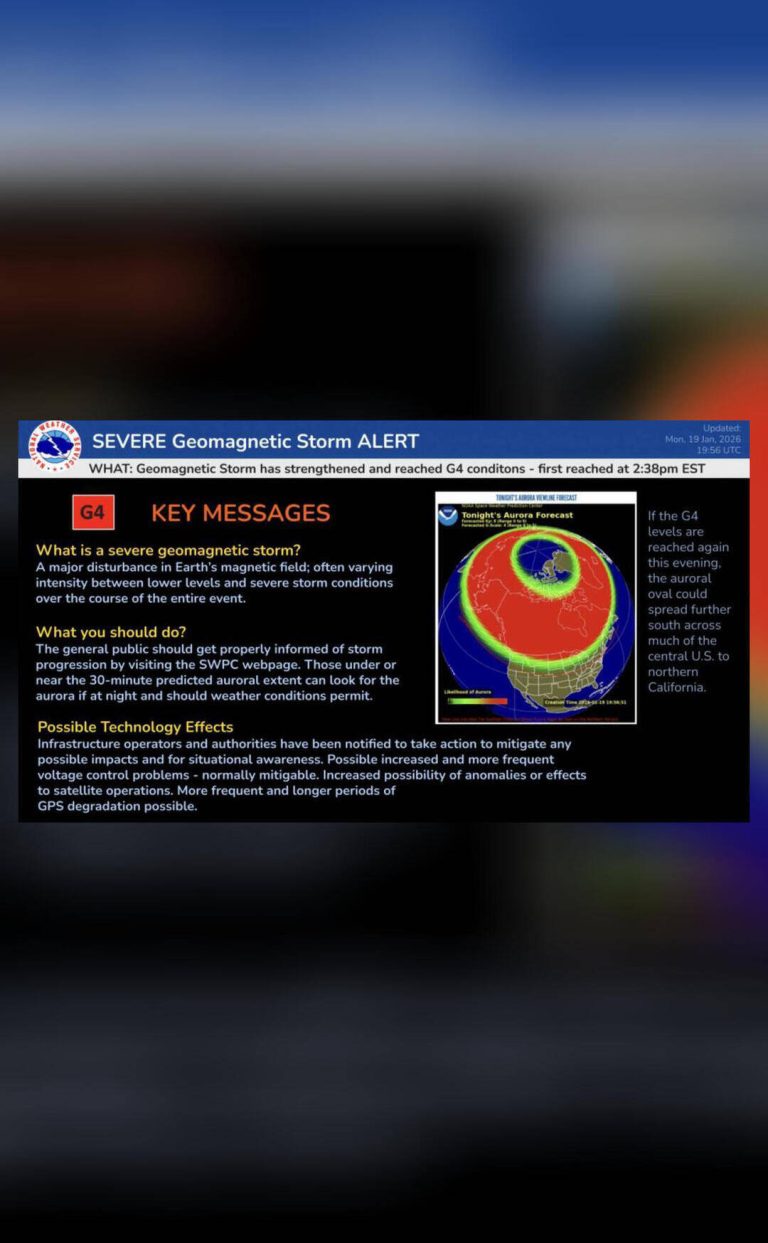
On Monday evening and early Tuesday morning, a powerful solar storm hit the Earth, creating dazzling auroral displays at several locations across the globe. This phenomenon, which is the largest solar storm in over 20 years, has the potential to disrupt satellite-based communications and GPS accuracy, making it a significant event for scientists and the general public alike.
Auroral displays, also known as the Northern or Southern Lights, are a natural phenomenon that occurs when charged particles from the sun interact with the Earth’s magnetic field and atmosphere. These particles are emitted by the sun during a solar flare or coronal mass ejection (CME), which is a massive burst of plasma and magnetic field that is released from the sun’s corona. When these particles reach the Earth, they collide with atoms and molecules in the atmosphere, causing them to excite and emit light, resulting in the breathtaking displays of colorful lights that we see in the sky.
The solar storm that hit the Earth on Monday evening and early Tuesday morning was caused by a CME that was emitted by the sun on Saturday. The CME was traveling at a speed of over 2 million miles per hour, making it one of the fastest and most powerful CMEs in recent years. As the CME interacted with the Earth’s magnetic field, it caused a geomagnetic storm, which is a temporary disturbance of the Earth’s magnetic field. This storm led to the spectacular auroral displays that were seen at several locations across the globe, including the northern United States, Canada, and Europe.
While the auroral displays were a sight to behold, the solar storm also has the potential to cause disruptions to our daily lives. One of the main concerns is the impact on satellite-based communications and GPS accuracy. The solar storm can cause signal delays and disruptions to satellite communications, which can affect a wide range of services, including navigation, communication, and weather forecasting. Additionally, the solar storm can also cause GPS signals to be delayed or distorted, which can affect the accuracy of GPS navigation systems.
Another concern is the increased radiation exposure risks for passengers on flights that are traveling polar routes. Solar radiation storms can cause increased radiation levels at high altitudes, which can pose a risk to passengers and crew on flights that are traveling over the polar regions. Airlines and aviation authorities are taking precautions to minimize the risks, including rerouting flights and providing protection to passengers and crew.
The solar storm has also sparked a lot of interest and excitement among scientists and space enthusiasts. The storm has provided a unique opportunity for scientists to study the effects of solar activity on the Earth’s magnetic field and atmosphere. The data collected from this event will help scientists to better understand the mechanisms that drive solar storms and their impact on our planet.
In conclusion, the largest solar storm in over 20 years has hit the Earth, causing dazzling auroral displays and disruptions to satellite-based communications and GPS accuracy. While the storm has caused some disruptions, it has also provided a unique opportunity for scientists to study the effects of solar activity on our planet. As we continue to monitor the situation, we are reminded of the awe-inspiring power of the sun and the importance of understanding and preparing for space weather events.
The solar storm is a reminder of the complex and dynamic relationship between the sun and the Earth. As we continue to explore and understand our place in the universe, we are constantly reminded of the importance of monitoring and preparing for space weather events. Whether you are a scientist, a space enthusiast, or simply someone who appreciates the beauty of the natural world, the solar storm is a fascinating event that is worth learning more about.
As we look to the future, it is clear that space weather events like the solar storm will continue to play a significant role in our lives. Whether it is disrupting satellite communications or causing spectacular auroral displays, the sun’s activity has the potential to impact our daily lives in many ways. By continuing to monitor and study space weather events, we can better understand the mechanisms that drive these events and take steps to prepare and mitigate their effects.
The solar storm has also sparked a lot of interest and conversation on social media, with many people sharing photos and videos of the auroral displays. The event has brought people together, with many sharing their experiences and observations of the storm. As we continue to learn more about the solar storm and its effects, we are reminded of the power of social media to connect people and facilitate the sharing of information and ideas.
In the end, the largest solar storm in over 20 years has been a significant event that has captured the attention of people around the world. Whether you are a scientist, a space enthusiast, or simply someone who appreciates the beauty of the natural world, the solar storm is a fascinating event that is worth learning more about. As we continue to monitor the situation and learn more about the effects of the storm, we are reminded of the awe-inspiring power of the sun and the importance of understanding and preparing for space weather events.
News Source: https://x.com/RT_com/status/2013348883477233817
About the Author