Largest Solar Storm in Over 20 Years Hits Earth
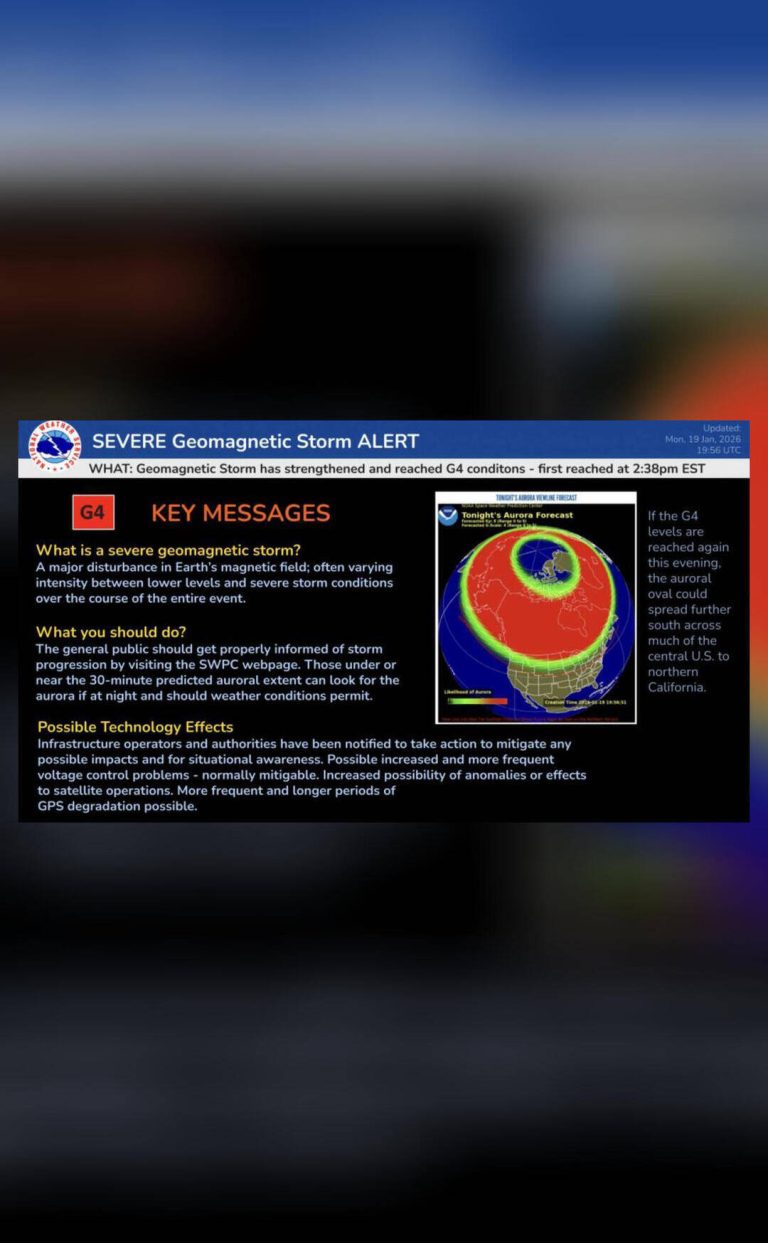
A powerful solar storm hit the Earth on Monday evening and early Tuesday morning, creating dazzling auroral displays at several locations across the globe. This solar storm, which is the largest in over 20 years, has the potential to disrupt satellite-based communications and GPS accuracy, posing a significant threat to our technological infrastructure. The storm also raises concerns about increased radiation exposure risks for passengers on flights traveling polar routes.
The solar storm, which was caused by a massive coronal mass ejection (CME) from the sun, was detected by scientists at the National Weather Service’s Space Weather Prediction Center (SWPC). The CME, which is a huge cloud of plasma and magnetic field, was ejected from the sun on Saturday and reached the Earth on Monday evening. The storm’s impact was felt across the globe, with auroral displays reported in countries such as the United States, Canada, and the United Kingdom.
The auroral displays, also known as the Northern Lights, were visible in the northernmost parts of the globe, including Alaska, Norway, and Sweden. The displays were characterized by vibrant colors and patterns, ranging from green and blue to red and purple. The spectacle was a treat for sky gazers and photographers, who were able to capture the stunning views of the aurora borealis.
However, the solar storm is not just a beautiful spectacle; it also poses a significant threat to our technological infrastructure. The storm’s magnetic field can interfere with satellite communications, GPS signals, and even power grids. This can cause disruptions to critical services such as navigation, communication, and transportation. The storm can also cause increased radiation exposure risks for passengers on flights traveling polar routes, as well as astronauts in space.
The SWPC has issued a warning about the potential disruptions caused by the solar storm. The warning states that the storm can cause “significant” disruptions to satellite communications, GPS signals, and power grids. The warning also advises passengers on flights traveling polar routes to be aware of the increased radiation exposure risks.
The solar storm is also a reminder of the importance of space weather forecasting. Space weather forecasting is the prediction of solar and geomagnetic activity, which can have a significant impact on our technological infrastructure. The SWPC uses a variety of tools and models to predict space weather events, including solar flares, CMEs, and geomagnetic storms.
The largest solar storm in over 20 years is a significant event that highlights the importance of space weather forecasting and the need for preparedness. The storm’s impact on our technological infrastructure is a reminder of the potential risks and consequences of space weather events. As our dependence on technology continues to grow, it is essential that we take steps to mitigate the risks associated with space weather events.
In conclusion, the largest solar storm in over 20 years has hit the Earth, creating dazzling auroral displays and posing a significant threat to our technological infrastructure. The storm’s impact on satellite communications, GPS signals, and power grids is a reminder of the importance of space weather forecasting and the need for preparedness. As we continue to explore and utilize space, it is essential that we take steps to mitigate the risks associated with space weather events.
News Source: https://x.com/RT_com/status/2013348883477233817
About the Author