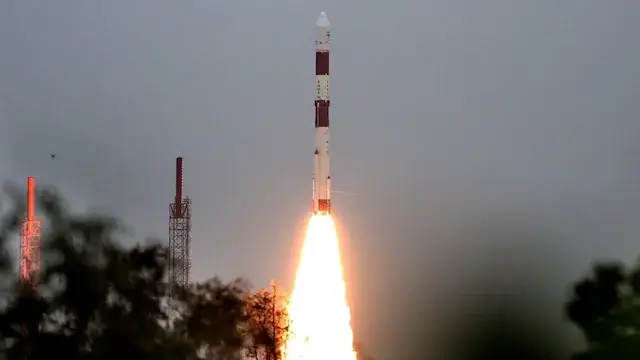
ISRO begins countdown for 1st launch of 2026 with PSLV-C62 mission
The Indian Space Research Organisation (ISRO) has commenced the countdown for its first launch mission of 2026, marking the beginning of a new year in space exploration for the country. The 22-hour countdown began at 12:48 pm for the PSLV-C62 mission, which aims to place the EOS-N1 Earth observation satellite and 15 co-passenger satellites into orbit. This mission is a significant milestone for ISRO, as it showcases the organization’s continued commitment to advancing India’s space program.
The PSLV rocket, which stands for Polar Satellite Launch Vehicle, is ISRO’s workhorse launch vehicle. With a proven track record of 63 flights, the PSLV has established itself as a reliable and efficient launch platform. One of its most notable missions was the Chandrayaan-1 lunar exploration mission, which marked a major breakthrough in India’s space program. The PSLV also holds the record for launching 104 satellites in a single mission, demonstrating its capability to carry out complex and high-volume launches.
The EOS-N1 Earth observation satellite is the primary payload of the PSLV-C62 mission. This satellite is designed to provide high-resolution imaging capabilities, which will be used for a variety of applications, including land use mapping, crop monitoring, and disaster management. The satellite’s advanced sensors and imaging technology will enable it to capture detailed images of the Earth’s surface, providing valuable data for scientists, researchers, and policymakers.
In addition to the EOS-N1 satellite, the PSLV-C62 mission will also carry 15 co-passenger satellites into orbit. These satellites are from various countries, including the United States, France, and India, and will be used for a range of purposes, including technology demonstration, scientific research, and commercial applications. The co-passenger satellites will be deployed into orbit using the PSLV’s multiple payload deployment system, which allows for the simultaneous launch of multiple satellites.
The PSLV-C62 mission is a significant milestone for ISRO, as it marks the beginning of a new year in space exploration for the country. The mission demonstrates ISRO’s continued commitment to advancing India’s space program, with a focus on developing new technologies, launching new satellites, and expanding the country’s presence in space. The success of the PSLV-C62 mission will pave the way for future launches, including more complex and ambitious missions, such as the Gaganyaan human spaceflight program.
The Gaganyaan program is a major initiative by ISRO to develop a human spaceflight capability, with the goal of sending Indian astronauts to space by 2025. The program involves the development of a new launch vehicle, the GSLV Mk III, as well as a crew module and other essential systems. The Gaganyaan program is a significant challenge for ISRO, but it also presents a major opportunity for the country to establish itself as a major player in the global space industry.
In addition to the Gaganyaan program, ISRO has a range of other initiatives and projects in the pipeline, including the development of new launch vehicles, satellites, and other space-related technologies. The organization is also working to expand its international collaborations and partnerships, with the goal of advancing global cooperation in space exploration and development.
The PSLV-C62 mission is a significant step forward for ISRO, as it demonstrates the organization’s continued commitment to advancing India’s space program. With its proven track record of success, the PSLV rocket is an essential part of ISRO’s launch capabilities, and the EOS-N1 satellite will provide valuable data and insights for scientists and researchers. As ISRO looks to the future, it is clear that the organization will continue to play a major role in shaping the country’s space program, with a focus on innovation, collaboration, and exploration.
In conclusion, the ISRO’s PSLV-C62 mission is a significant milestone for the country’s space program, marking the beginning of a new year in space exploration. With the launch of the EOS-N1 Earth observation satellite and 15 co-passenger satellites, the mission demonstrates ISRO’s continued commitment to advancing India’s space program, with a focus on developing new technologies, launching new satellites, and expanding the country’s presence in space. As ISRO looks to the future, it is clear that the organization will continue to play a major role in shaping the country’s space program, with a focus on innovation, collaboration, and exploration.
News Source: https://x.com/PTI_News/status/2010285538843173209
About the Author