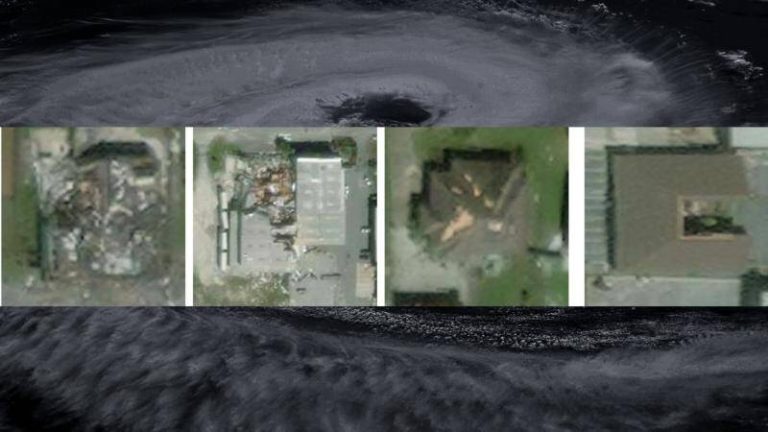
IIT Bombay’s AI speeds up hurricane damage assessment
Hurricanes are one of the most destructive natural disasters, causing widespread damage to infrastructure, properties, and human life. The aftermath of a hurricane is a critical period, where timely assessment of the damage is essential for effective disaster response and relief efforts. However, traditional methods of damage assessment are time-consuming, labor-intensive, and often inaccurate. To address this challenge, researchers at the Indian Institute of Technology (IIT) Bombay have developed an artificial intelligence (AI) model that can rapidly identify building damage from aerial images, revolutionizing the field of disaster response.
The AI model, called SpADANet, is a spatially aware deep learning network that uses aerial images to assess building damage after a hurricane. What makes SpADANet unique is its ability to overcome the “domain gap,” which refers to the difference in appearance between images taken during different storms. Traditional AI models struggle to adapt to new environments, requiring large amounts of labeled data to learn from. SpADANet, on the other hand, can learn from a small amount of data and still achieve high accuracy, making it an ideal solution for real-time disaster response.
One of the key features of SpADANet is its ability to use spatial context to identify building damage. The model takes into account the spatial relationships between buildings, roads, and other infrastructure, allowing it to better understand the context of the damage. This is particularly important in urban areas, where buildings are densely packed, and damage can be extensive. By using spatial context, SpADANet can outperform existing methods, which often rely on simple image classification techniques.
Another significant advantage of SpADANet is its optimization for mobile devices. The model is designed to be lightweight and efficient, allowing it to run on mobile devices with limited computational resources. This makes it an ideal solution for disaster response teams, who often work in remote areas with limited access to high-performance computing infrastructure. With SpADANet, teams can quickly assess damage using mobile devices, enabling them to respond more effectively to disasters.
The development of SpADANet has significant implications for disaster response and relief efforts globally. Hurricanes are a major threat to many countries, particularly those in the tropics. The ability to quickly assess damage and respond effectively can save lives, reduce economic losses, and minimize the impact of disasters on communities. SpADANet has the potential to become a critical tool in the disaster response toolkit, enabling teams to respond more quickly and effectively to hurricanes and other natural disasters.
The researchers at IIT Bombay who developed SpADANet are excited about the potential of their model to make a positive impact on disaster response efforts. “Our goal is to use AI to improve the speed and accuracy of damage assessment, enabling disaster response teams to respond more effectively to hurricanes and other natural disasters,” said one of the researchers. “We believe that SpADANet has the potential to become a game-changer in the field of disaster response, and we are committed to continuing to develop and refine the model to meet the needs of disaster response teams around the world.”
In conclusion, the development of SpADANet by IIT Bombay researchers is a significant breakthrough in the field of disaster response. The AI model’s ability to rapidly identify building damage from aerial images, overcome the “domain gap,” and use spatial context to outperform existing methods makes it an ideal solution for real-time disaster response. With its optimization for mobile devices, SpADANet has the potential to become a critical tool in the disaster response toolkit, enabling teams to respond more quickly and effectively to hurricanes and other natural disasters. As the world becomes increasingly vulnerable to natural disasters, the development of innovative solutions like SpADANet is more important than ever.
News Source: https://researchmatters.in/news/novel-spatially-aware-ai-model-makes-hurricane-damage-assessment-more-accurate
About the Author