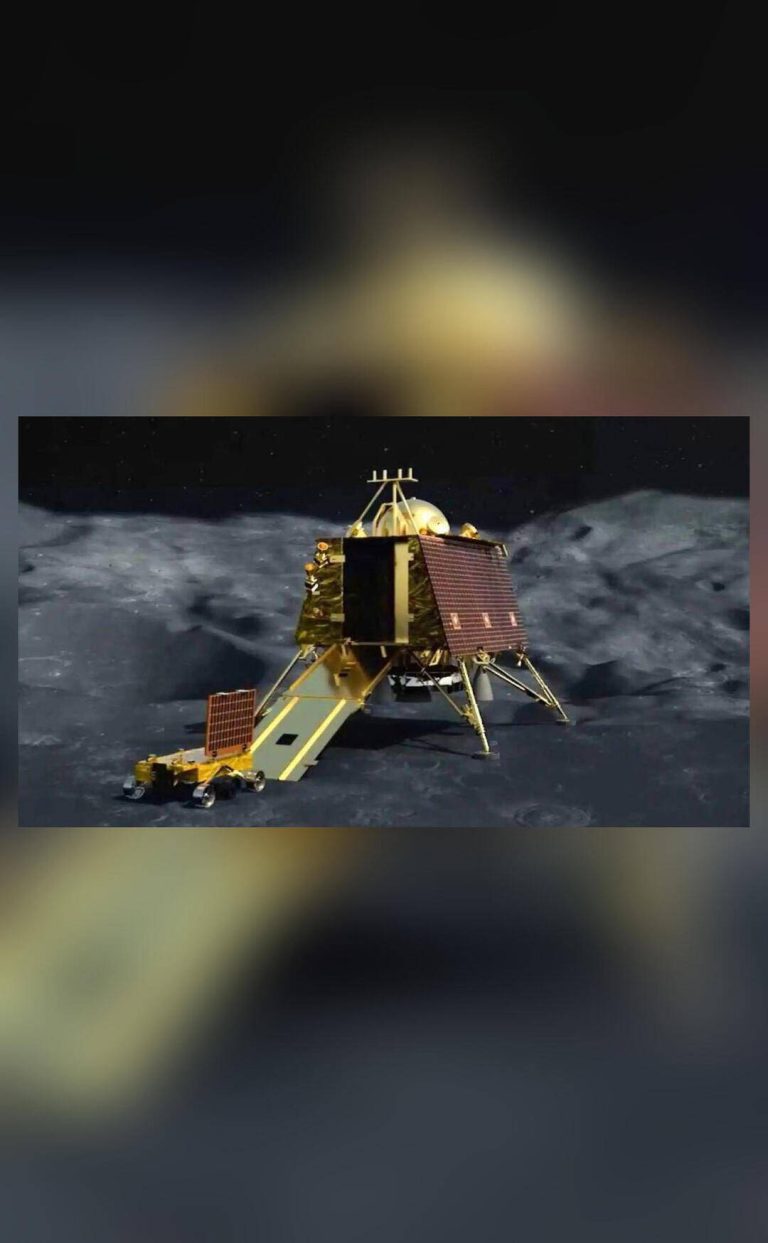
How Moon altered the orbit of Chandrayaan-3’s propulsion module?
In a remarkable demonstration of celestial mechanics, the Indian Space Research Organisation’s (ISRO) Chandrayaan-3 mission has achieved a significant milestone. The spacecraft’s propulsion module, which is currently in Earth’s orbit, underwent a substantial change in its trajectory after passing close to the Moon on two separate occasions in November 2025. This alteration in the module’s orbit was made possible by the Moon’s gravity, which pulled the spacecraft during two flybys, without the need for any fuel consumption.
The first flyby occurred on November 6, when the propulsion module came within 3,740 km of the Moon’s surface. The second flyby took place on November 11, at a distance of 4,537 km. During these close encounters, the Moon’s gravitational force exerted a significant influence on the spacecraft, naturally altering its path. As a result, the propulsion module’s orbit size and direction were changed, marking a significant achievement for the Chandrayaan-3 mission.
The concept of using a celestial body’s gravity to alter a spacecraft’s trajectory is not new. This technique, known as a gravity assist, has been employed by space agencies around the world to change the course of spacecraft and save fuel. By flying a spacecraft close to a planet or moon, the spacecraft can harness the celestial body’s gravity to gain speed and alter its trajectory. This technique has been used in numerous interplanetary missions, including the Voyager and Cassini missions.
In the case of the Chandrayaan-3 propulsion module, the gravity assist provided by the Moon’s gravity has resulted in a significant change in its orbit. The module’s orbit size and direction have been altered, which will have implications for the spacecraft’s future trajectory. The ISRO has confirmed that the orbit change was achieved without the use of any fuel, which is a significant advantage for the mission.
The Chandrayaan-3 mission is a follow-up to the Chandrayaan-1 and Chandrayaan-2 missions, which were launched in 2008 and 2019, respectively. The mission aims to demonstrate the capability to soft-land a rover on the lunar surface and conduct scientific experiments. The propulsion module, which is currently in Earth’s orbit, will play a crucial role in the mission by providing the necessary propulsion for the spacecraft to reach the lunar surface.
The success of the gravity assist maneuver is a testament to the ISRO’s expertise in spacecraft operations and navigation. The agency has demonstrated its ability to precision-fly a spacecraft and harness the gravity of a celestial body to alter its trajectory. This achievement will have significant implications for future interplanetary missions, where gravity assists will be used to change the course of spacecraft and save fuel.
The Chandrayaan-3 mission is expected to provide significant scientific returns, including high-resolution images of the lunar surface, compositional information, and geophysical data. The mission will also demonstrate the capability to soft-land a rover on the lunar surface, which will pave the way for future human missions to the Moon.
In conclusion, the alteration of the Chandrayaan-3 propulsion module’s orbit by the Moon’s gravity is a significant achievement for the ISRO. The use of gravity assists to change the trajectory of spacecraft will continue to play a crucial role in future interplanetary missions. As space agencies around the world continue to explore the solar system, the use of gravity assists will become increasingly important for achieving mission objectives and saving fuel.
The success of the Chandrayaan-3 mission will also have significant implications for the Indian space program, which has been rapidly expanding in recent years. The ISRO has demonstrated its capability to launch complex spacecraft and conduct precision operations, which will pave the way for future missions to the Moon and beyond.
As we continue to explore the solar system, the use of gravity assists will become increasingly important for achieving mission objectives and saving fuel. The Chandrayaan-3 mission has demonstrated the effectiveness of this technique, and it will be interesting to see how future missions will utilize gravity assists to change the course of spacecraft and explore the vast expanse of space.
About the Author