First Detailed Look at Tsunami Captured from Space by NASA
Tsunamis have long been a topic of fascination and fear for scientists and the general public alike. These massive waves, triggered by earthquakes, landslides, or volcanic eruptions, can cause widespread destruction and loss of life. While we have made significant progress in understanding tsunamis, there is still much to be learned about these complex and powerful phenomena. Recently, NASA and the French space agency CNES (Centre National d’Etudes Spatiales) have made a groundbreaking achievement in this field. Their SWOT (Surface Water and Ocean Topography) satellite has captured the first detailed look at a tsunami from space, providing unprecedented insights into the behavior of these waves.
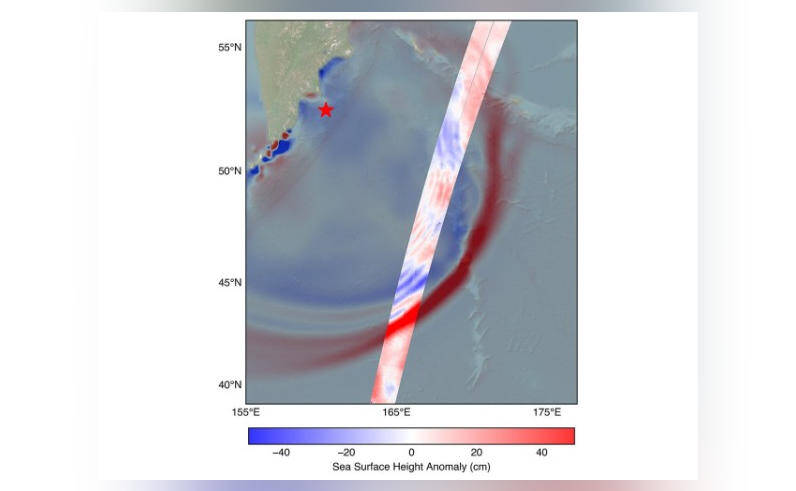
On July 30, a massive 8.8 magnitude earthquake struck off the coast of Russia’s Kamchatka peninsula, generating a tsunami that traveled across the Pacific Ocean. The SWOT satellite, launched in December 2022, was in the perfect position to track the waves generated by this earthquake. The satellite’s advanced instruments, designed to study the ocean’s surface and topography, allowed scientists to observe the tsunami in unprecedented detail. The data collected by SWOT has challenged our earlier understanding of tsunamis, revealing that they do not maintain a single, uniform form as previously thought.
According to the data collected by SWOT, the tsunami split into multiple waves, with a large leading wave followed by smaller ones. This discovery has significant implications for our understanding of tsunami behavior and the potential impact on coastal communities. The traditional view of tsunamis as a single, massive wave has been widely accepted, but the new data suggests that the reality is more complex. The leading wave, often referred to as the ” tsunami wave,” is indeed the largest and most destructive, but it is followed by a series of smaller waves that can still cause significant damage.
The SWOT satellite’s ability to track the tsunami waves in such detail is a testament to its advanced technology. The satellite uses a combination of radar and lidar (light detection and ranging) instruments to study the ocean’s surface and topography. This allows scientists to create high-resolution maps of the ocean’s surface, including the height and shape of waves. In the case of the Kamchatka tsunami, SWOT was able to track the waves as they traveled across the Pacific, providing a unique perspective on the behavior of these massive waves.
The implications of this discovery are significant, as it challenges our current understanding of tsunami behavior and the potential impact on coastal communities. The fact that tsunamis can split into multiple waves, with a large leading wave followed by smaller ones, means that the traditional models used to predict tsunami behavior may need to be revised. This, in turn, could lead to more accurate predictions and warnings, potentially saving lives and reducing damage to coastal infrastructure.
The SWOT satellite’s achievement is not only significant for our understanding of tsunamis but also for the field of oceanography as a whole. The satellite’s advanced instruments and capabilities will allow scientists to study the ocean’s surface and topography in unprecedented detail, shedding new light on the complex processes that shape our planet. From ocean currents and waves to sea level rise and coastal erosion, the SWOT satellite will provide a wealth of new data and insights, helping us better understand the intricate relationships between the ocean, atmosphere, and land.
In conclusion, the first detailed look at a tsunami captured from space by NASA’s SWOT satellite is a groundbreaking achievement that challenges our current understanding of these complex phenomena. The discovery that tsunamis can split into multiple waves, with a large leading wave followed by smaller ones, has significant implications for our understanding of tsunami behavior and the potential impact on coastal communities. As we continue to study the ocean and its many mysteries, the SWOT satellite will play a vital role in advancing our knowledge and helping us better prepare for the challenges that lie ahead.
About the Author