First detailed look at tsunami captured from space by NASA
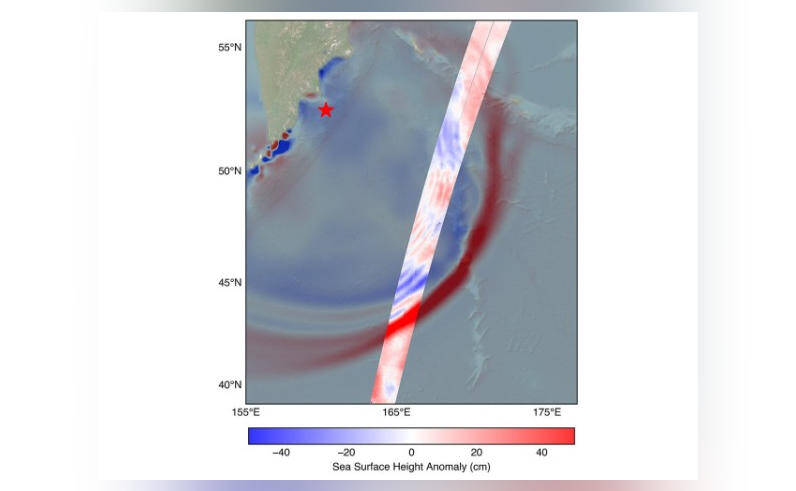
In a groundbreaking achievement, NASA and the Centre National d’Etudes Spatiales (CNES) have successfully captured the first detailed look at a tsunami from space using their SWOT (Surface Water and Ocean Topography) satellite. This remarkable feat was made possible when the system tracked the waves generated by the 8.8 magnitude earthquake that occurred off Russia’s Kamchatka peninsula on July 30. The findings have not only provided scientists with a unique insight into the behavior of tsunamis but have also challenged earlier beliefs about the characteristics of these massive waves.
The SWOT satellite, launched in December 2022, is a collaborative mission between NASA and CNES, designed to study the world’s oceans and surface water. Equipped with advanced instruments, the satellite is capable of measuring the height of the ocean’s surface with unprecedented precision, allowing scientists to track even the slightest changes in the ocean’s topography. This capability has proven to be instrumental in capturing the detailed look at the tsunami, providing valuable data that will help scientists better understand the dynamics of these powerful waves.
The earthquake that occurred off Russia’s Kamchatka peninsula on July 30 was a significant event, with a magnitude of 8.8. The quake generated a tsunami that traveled across the Pacific Ocean, posing a threat to several coastal communities. Fortunately, the tsunami warning systems in place were able to alert authorities, and evacuations were carried out, minimizing the impact of the disaster. However, the event presented a unique opportunity for scientists to study the behavior of tsunamis in real-time, using the SWOT satellite.
The data collected by the SWOT satellite has revealed that the tsunami did not behave as previously thought. Instead of maintaining a single, uniform form, the tsunami split into multiple waves, with a large leading wave followed by smaller ones. This discovery has significant implications for our understanding of tsunamis and how they interact with the ocean and coastal communities. The findings suggest that tsunamis are more complex and dynamic than previously thought, and that their behavior can vary greatly depending on the specific conditions of the earthquake and the ocean.
The ability to track tsunamis from space has the potential to revolutionize the way we predict and prepare for these disasters. By providing detailed information about the size, shape, and behavior of tsunamis, scientists can develop more accurate models of these events, allowing for earlier and more effective warnings. This, in turn, can help save lives and reduce the impact of tsunamis on coastal communities.
The SWOT satellite’s capability to capture detailed images of tsunamis from space is a significant breakthrough, and one that will have far-reaching implications for the field of oceanography and disaster management. The satellite’s advanced instruments and precise measurements have provided scientists with a unique window into the behavior of tsunamis, allowing them to study these events in unprecedented detail.
The discovery that tsunamis can split into multiple waves has significant implications for tsunami warning systems. Currently, these systems rely on simple models of tsunami behavior, which assume that the wave will maintain a uniform shape and size as it travels across the ocean. However, the new data suggests that this may not always be the case, and that tsunamis can behave in more complex and unpredictable ways. By taking into account the possibility of multiple waves, scientists can develop more accurate and effective warning systems, which can provide earlier and more reliable alerts to coastal communities.
In addition to its implications for tsunami warning systems, the discovery of multiple waves has also shed new light on the dynamics of tsunamis. Scientists have long known that tsunamis are capable of traveling at high speeds, often exceeding 500 miles per hour. However, the new data suggests that the speed and behavior of tsunamis can vary greatly depending on the specific conditions of the earthquake and the ocean. By studying the behavior of tsunamis in more detail, scientists can gain a better understanding of the underlying dynamics of these events, which can help inform the development of more accurate models and prediction systems.
The use of satellite technology to study tsunamis is not new, but the SWOT satellite’s advanced instruments and precise measurements have taken this field to a new level. The satellite’s capability to track tsunamis from space has provided scientists with a unique perspective on these events, allowing them to study the behavior of tsunamis in unprecedented detail. The data collected by the SWOT satellite will be invaluable for scientists, policymakers, and emergency responders, who will be able to use this information to develop more effective warning systems and mitigation strategies.
In conclusion, the first detailed look at a tsunami captured from space by NASA’s SWOT satellite is a significant achievement, one that has the potential to revolutionize our understanding of these powerful waves. The discovery that tsunamis can split into multiple waves has challenged earlier beliefs about the behavior of these events, and has highlighted the complexity and dynamics of tsunamis. As scientists continue to study the data collected by the SWOT satellite, they will gain a better understanding of the underlying dynamics of tsunamis, which will inform the development of more accurate models and prediction systems. This, in turn, will help save lives and reduce the impact of tsunamis on coastal communities.
About the Author