First Detailed Look at Tsunami Captured from Space by NASA
The field of space exploration and Earth observation has taken a significant leap forward with the recent capture of a tsunami from space by NASA and the French space agency, CNES. The SWOT (Surface Water and Ocean Topography) satellite, a joint mission between the two space agencies, has provided the first detailed look at a tsunami, challenging earlier beliefs about the behavior of these massive waves. In this blog post, we will delve into the details of this groundbreaking observation and explore its significance.
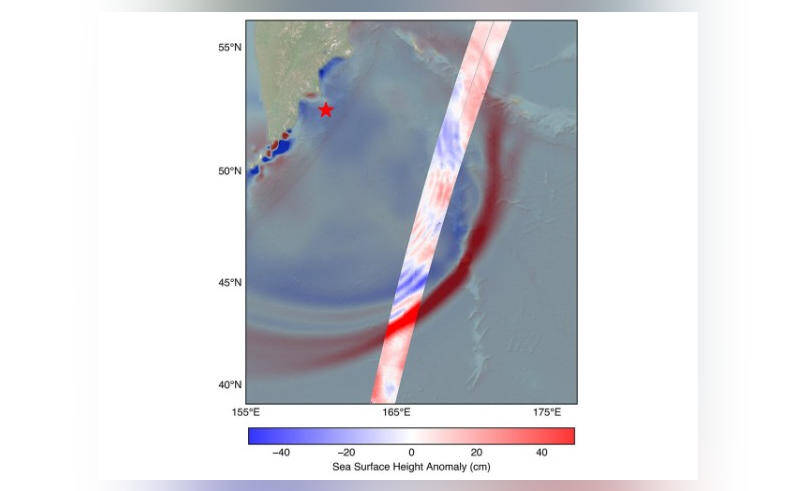
On July 30, a powerful 8.8 magnitude earthquake struck off the coast of Russia’s Kamchatka peninsula, generating a tsunami that traveled across the Pacific Ocean. The SWOT satellite, launched in December 2022, was in the perfect position to capture the event. Equipped with advanced radar and lidar instruments, the satellite is designed to study the Earth’s oceans, lakes, and rivers, providing unprecedented insights into the planet’s water cycle and ocean dynamics.
The data collected by the SWOT satellite revealed a complex and dynamic picture of the tsunami. Contrary to the earlier belief that tsunamis maintain a single, uniform form, the satellite’s observations showed that the waves split into multiple waves, with a large leading wave followed by smaller ones. This discovery has significant implications for our understanding of tsunami behavior and could potentially improve early warning systems and mitigation strategies.
The SWOT satellite’s ability to capture the tsunami from space is a testament to the cutting-edge technology employed by the mission. The satellite’s radar instrument, known as the Ka-band Radar Interferometer (KaRIn), uses a technique called interferometry to measure the height of the ocean surface with unprecedented accuracy. This allows scientists to track the movement of waves and currents in the ocean with great precision, providing valuable insights into the dynamics of the ocean and its impact on the planet.
The observation of the tsunami by the SWOT satellite is not only a significant scientific achievement but also has practical implications. Tsunamis are among the most destructive natural disasters, causing widespread damage and loss of life. The ability to track tsunamis from space could provide early warning systems with critical information, enabling authorities to evacuate people and take necessary precautions to minimize the impact of the disaster.
The SWOT satellite’s capture of the tsunami is also a demonstration of the power of international collaboration in space exploration. The joint mission between NASA and CNES brings together the expertise and resources of two of the world’s leading space agencies, enabling scientists to tackle complex challenges that would be difficult to address alone. The success of the SWOT mission is a testament to the benefits of collaboration and cooperation in the pursuit of scientific knowledge.
In addition to its implications for tsunami research, the SWOT satellite’s observations have broader implications for our understanding of the ocean and its role in the Earth’s climate system. The satellite’s data will help scientists to better understand ocean currents, waves, and tides, which are critical components of the global ocean circulation. This knowledge will be essential for predicting future changes in the ocean and its impact on the planet, including sea level rise, ocean acidification, and the distribution of heat around the globe.
In conclusion, the capture of the tsunami by the SWOT satellite is a groundbreaking achievement that has significant implications for our understanding of these massive waves and their behavior. The discovery that tsunamis can split into multiple waves challenges earlier beliefs and highlights the complexity and dynamics of these events. The success of the SWOT mission is a testament to the power of international collaboration and the importance of continued investment in space exploration and Earth observation.
As we continue to explore and understand our planet, missions like SWOT will play a critical role in providing us with the knowledge and insights needed to address the complex challenges facing our planet. The observation of the tsunami from space is a reminder of the awe-inspiring power of the ocean and the importance of continued research and monitoring to better understand and predict its behavior.
About the Author