First detailed look at tsunami captured from space by NASA
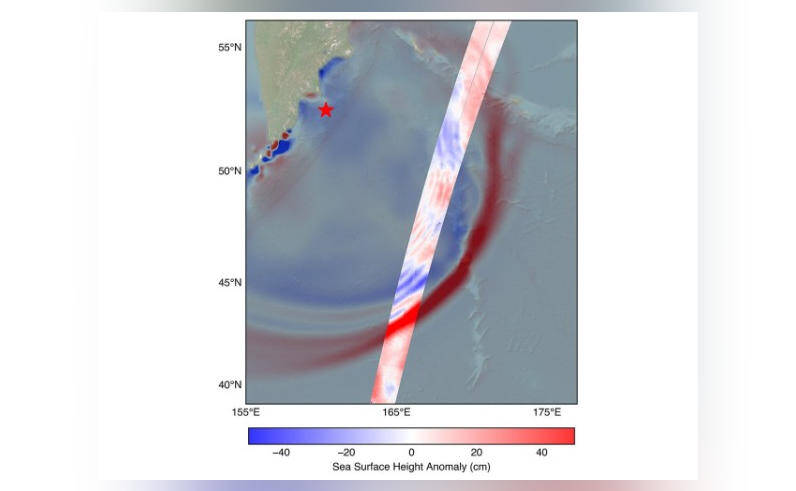
In a groundbreaking achievement, NASA and the French space agency CNES’s SWOT (Surface Water and Ocean Topography) satellite have successfully captured the first detailed look at a tsunami from space. This unprecedented observation was made possible when the system tracked the waves generated by the 8.8 magnitude earthquake that struck off Russia’s Kamchatka peninsula on July 30. The findings of this study have significant implications for our understanding of tsunamis and how they behave, challenging earlier beliefs and paving the way for improved early warning systems.
The SWOT satellite, launched in December 2022, is designed to study the world’s oceans and surface water. Equipped with advanced radar technology, it can detect even slight changes in sea level, making it an ideal tool for monitoring tsunamis. When the 8.8 magnitude earthquake occurred off the coast of Kamchatka, the SWOT satellite was in the perfect position to capture the resulting tsunami waves. The data collected by the satellite has provided scientists with a unique opportunity to study the behavior of tsunamis in unprecedented detail.
One of the most significant discoveries made by the scientists analyzing the SWOT data is that the tsunami did not maintain a single, uniform form as it traveled across the ocean. Instead, it split into multiple waves, with a large leading wave followed by smaller ones. This challenges the earlier belief that tsunamis typically maintain a single, uniform wave form. The discovery of this complex wave pattern has important implications for tsunami modeling and prediction, as it suggests that the behavior of tsunamis is more complex and dynamic than previously thought.
The SWOT satellite’s ability to capture the detailed behavior of the tsunami waves is a significant advancement in the field of tsunami research. Previous studies have relied on limited data from coastal monitoring stations and buoy networks, which can only provide a glimpse into the behavior of tsunamis. The SWOT satellite’s global coverage and high-resolution data have enabled scientists to study the tsunami waves in unprecedented detail, providing a more complete understanding of their behavior and dynamics.
The discovery of the complex wave pattern has significant implications for tsunami early warning systems. Current warning systems rely on simple models that assume a single, uniform wave form. However, the SWOT data suggests that tsunamis can exhibit more complex behavior, which could impact the accuracy of these warning systems. By incorporating the new findings into tsunami models, scientists can develop more accurate and reliable early warning systems, which could help save lives and reduce the impact of tsunamis on coastal communities.
The SWOT satellite’s observations also have important implications for our understanding of ocean dynamics and the behavior of tsunamis in different ocean environments. The satellite’s data has shown that the tsunami waves interacted with the ocean’s currents and topography, causing the waves to change direction and speed. This interaction between the tsunami waves and the ocean environment is critical to understanding how tsunamis behave and how they can be predicted.
In addition to the scientific implications, the SWOT satellite’s observations also have significant practical applications. The data collected by the satellite can be used to improve tsunami early warning systems, which can help save lives and reduce the impact of tsunamis on coastal communities. The satellite’s observations can also be used to study the impact of tsunamis on coastal ecosystems and to develop more effective strategies for mitigating the effects of tsunamis.
In conclusion, the SWOT satellite’s capture of the first detailed look at a tsunami from space is a significant achievement that has challenged our earlier understanding of tsunamis and their behavior. The discovery of the complex wave pattern and the interaction between the tsunami waves and the ocean environment has important implications for tsunami modeling and prediction, as well as for the development of early warning systems. As the SWOT satellite continues to collect data, scientists will have a unique opportunity to study tsunamis in unprecedented detail, leading to a better understanding of these powerful and destructive events.
About the Author