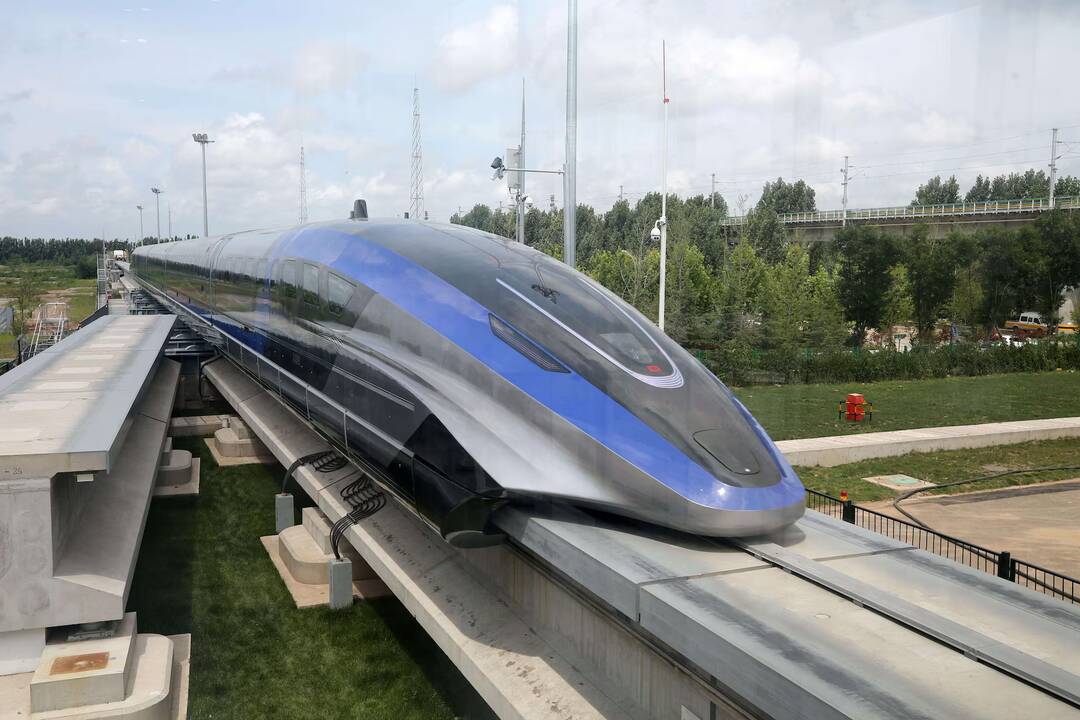
China accelerates vehicle to 700 km/h in 2 secs in magnetic levitation test
In a groundbreaking achievement, researchers in China have successfully accelerated a tonne-class vehicle to a staggering speed of 700 km/h within a mere two seconds. This remarkable feat was accomplished using a magnetic levitation (maglev) test line, which has now earned the distinction of being the fastest superconductive electric maglev system in the world. According to state broadcaster China Central Television, the test was conducted by China’s National University of Defense Technology, utilizing a 1,310-foot track to achieve this incredible speed.
The concept of magnetic levitation, or maglev, has been around for several decades. It involves using magnetic forces to levitate and propel vehicles at high speeds, eliminating the need for traditional wheels and rails. This technology has the potential to revolutionize the transportation industry, offering faster, cleaner, and more efficient travel options. China has been at the forefront of maglev research and development, with several high-profile projects already underway.
The recent test, conducted by the National University of Defense Technology, marks a significant milestone in the development of maglev technology. The vehicle used in the test was a tonne-class model, which is a substantial size, and accelerating it to 700 km/h in just two seconds is a remarkable achievement. To put this speed into perspective, it’s equivalent to traveling from New York to Los Angeles in under four hours. The test demonstrates the immense potential of maglev technology and its ability to achieve incredibly high speeds with remarkable efficiency.
The test track used in the experiment was 1,310 feet long, which may seem relatively short, but it’s sufficient to demonstrate the capabilities of the maglev system. The track is equipped with advanced magnetic levitation technology, which uses superconducting magnets to levitate and propel the vehicle. The system is designed to minimize friction and maximize efficiency, allowing the vehicle to reach high speeds in a remarkably short time.
The implications of this breakthrough are far-reaching. Maglev technology has the potential to transform the transportation industry, offering faster, cleaner, and more efficient travel options. With the ability to reach speeds of over 700 km/h, maglev systems could revolutionize the way we travel, making long-distance journeys faster and more convenient. Additionally, maglev technology has the potential to reduce greenhouse gas emissions, as it is a clean and energy-efficient mode of transportation.
China’s achievements in maglev technology are a testament to the country’s commitment to innovation and research. The National University of Defense Technology has been at the forefront of maglev research, and this recent breakthrough is a significant milestone in the development of this technology. As China continues to invest in maglev research and development, we can expect to see even more impressive achievements in the future.
The success of the maglev test has also sparked interest and excitement among the scientific community. Experts around the world are eagerly watching China’s progress in maglev technology, and many are predicting that this technology will play a major role in shaping the future of transportation. With its potential to achieve incredibly high speeds, reduce emissions, and increase efficiency, maglev technology is an exciting and promising area of research.
In conclusion, China’s recent achievement in accelerating a vehicle to 700 km/h in just two seconds using magnetic levitation technology is a groundbreaking milestone. The test demonstrates the immense potential of maglev technology and its ability to achieve incredibly high speeds with remarkable efficiency. As China continues to invest in maglev research and development, we can expect to see even more impressive achievements in the future. With its potential to transform the transportation industry, maglev technology is an exciting and promising area of research that is worth watching.
About the Author