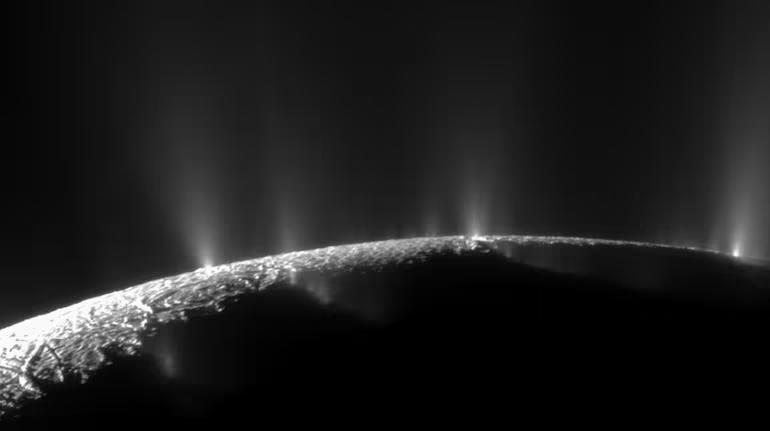
Cassini finds fresh organic molecules on Saturn’s Moon
The search for life beyond Earth has been a long-standing quest for scientists and space enthusiasts alike. While we have not yet found definitive evidence of extraterrestrial life, recent discoveries have brought us closer to understanding the potential for life to exist elsewhere in our solar system. One such discovery was made by NASA’s Cassini mission, which has been exploring the Saturn system since 2004. In a groundbreaking finding, Cassini has detected fresh, complex organic molecules erupting from the subsurface ocean of Saturn’s moon Enceladus.
The Cassini spacecraft, flying just 13 miles above the surface of Enceladus, sampled ice grains in active plumes and found a wide range of organic compounds, including aliphatic, cyclic, nitrogen- and oxygen-bearing molecules, as well as double-bonded molecules. These findings are significant because they suggest that the subsurface ocean of Enceladus has the necessary ingredients for life to exist. The presence of complex organic molecules, which are the building blocks of life, is a key indicator of the potential for life to thrive in a given environment.
The discovery was made possible by Cassini’s Cosmic Dust Analyzer (CDA) instrument, which is capable of detecting and analyzing the composition of tiny particles in the plumes of Enceladus. The CDA instrument uses a combination of mass spectrometry and dust impact detection to identify the chemical makeup of the particles. By flying the spacecraft through the plumes and collecting data from the CDA instrument, scientists were able to determine the composition of the ice grains and the organic molecules they contain.
The findings support evidence that Enceladus could be habitable, meaning that it has the necessary conditions to support life. The moon’s subsurface ocean, which is thought to be in contact with rock, is a potential source of energy and nutrients for life. The presence of complex organic molecules in the plumes suggests that the ocean is capable of producing these molecules, which could then be used to support life.
The discovery of organic molecules on Enceladus is not the first time that such molecules have been found in our solar system. In recent years, NASA’s Curiosity rover has discovered evidence of organic molecules on Mars, and the European Space Agency’s Rosetta mission has found organic molecules in the coma of Comet 67P/Churyumov-Gerasimenko. However, the discovery on Enceladus is significant because it suggests that the moon’s subsurface ocean is a potential source of life.
The implications of this discovery are far-reaching. If Enceladus is found to be habitable, it could have significant implications for our understanding of the origins of life in the universe. The discovery of life on another planet or moon would be a major breakthrough, and would raise important questions about the possibility of life existing elsewhere in the universe.
The Cassini mission has been a groundbreaking success, and has greatly expanded our understanding of the Saturn system. The mission has discovered new moons, rings, and geysers, and has provided a wealth of information about the composition and atmosphere of the planets and moons in the system. The discovery of organic molecules on Enceladus is a fitting finale to the mission, which ended in 2017 when the spacecraft was intentionally crashed into Saturn’s atmosphere.
In conclusion, the discovery of fresh, complex organic molecules on Enceladus is a significant finding that suggests the moon’s subsurface ocean could be habitable. The presence of these molecules, which are the building blocks of life, is a key indicator of the potential for life to exist on the moon. The discovery is a testament to the power of space exploration and the importance of continuing to explore our solar system for signs of life. As we continue to explore and learn more about the universe, we may one day find definitive evidence of life beyond Earth.
About the Author