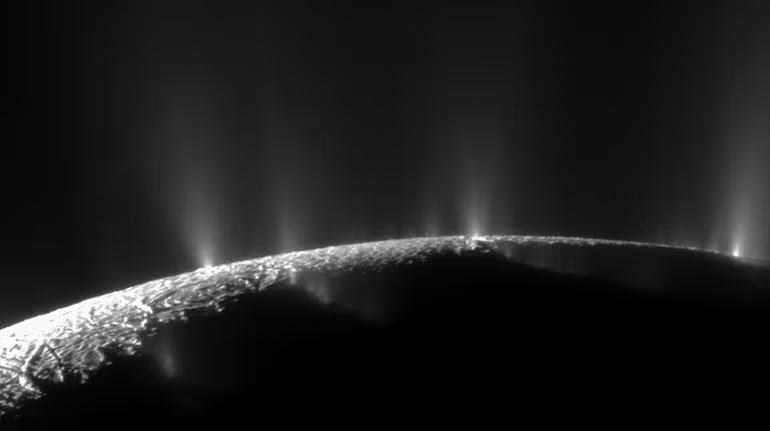
Cassini finds fresh organic molecules on Saturn’s Moon
In a groundbreaking discovery, NASA’s Cassini mission has detected fresh, complex organic molecules erupting from the subsurface ocean of Saturn’s moon Enceladus. The spacecraft, flying just 13 miles above the surface, sampled ice grains in active plumes and found aliphatic, cyclic, nitrogen- and oxygen-bearing compounds, including double-bonded molecules. This remarkable finding has significant implications for the search for life beyond Earth and supports evidence that Enceladus could be habitable.
The Cassini mission, which was launched in 1997 and ended in 2017, was designed to study the Saturn system, including its rings, moons, and magnetic field. During its 13-year journey, the spacecraft made numerous discoveries that have revolutionized our understanding of the Saturn system. One of the most fascinating discoveries was the presence of a subsurface ocean on Enceladus, which is thought to be in contact with rock, making it a potential habitat for life.
The detection of fresh organic molecules on Enceladus is a significant finding because it suggests that the moon’s subsurface ocean is capable of producing complex organic compounds. These compounds are the building blocks of life and are essential for the emergence of biological systems. The fact that the molecules are fresh and complex indicates that they are being produced continuously, which is a strong indication of a dynamic and active system.
The Cassini spacecraft was able to sample the ice grains in the plumes of Enceladus by flying through the plumes and collecting data on the composition of the particles. The spacecraft was equipped with a range of instruments, including a mass spectrometer, which was used to analyze the chemical composition of the particles. The data collected by the spacecraft revealed the presence of a wide range of organic molecules, including aliphatic and cyclic compounds, as well as nitrogen- and oxygen-bearing compounds.
The presence of double-bonded molecules is particularly significant because it suggests that the organic compounds on Enceladus are being produced through a process that involves the interaction of water and rock. This process, known as hydrothermal activity, is thought to be a key factor in the emergence of life on Earth and is believed to be present on Enceladus as well.
The discovery of fresh organic molecules on Enceladus has significant implications for the search for life beyond Earth. The presence of complex organic compounds on the moon suggests that the conditions on Enceladus are suitable for the emergence of life. The fact that the molecules are being produced continuously indicates that the system is dynamic and active, which is a key factor in the search for life.
The search for life beyond Earth is one of the most fascinating and complex questions in science. The discovery of exoplanets, which are planets that orbit stars other than the Sun, has revealed that the universe is teeming with planets that are similar to Earth. However, the search for life on these planets is a challenging task that requires the development of new technologies and strategies.
The discovery of fresh organic molecules on Enceladus is a significant step forward in the search for life beyond Earth. The presence of complex organic compounds on the moon suggests that the conditions on Enceladus are suitable for the emergence of life. The fact that the molecules are being produced continuously indicates that the system is dynamic and active, which is a key factor in the search for life.
In conclusion, the discovery of fresh organic molecules on Enceladus is a groundbreaking finding that has significant implications for the search for life beyond Earth. The presence of complex organic compounds on the moon suggests that the conditions on Enceladus are suitable for the emergence of life. The fact that the molecules are being produced continuously indicates that the system is dynamic and active, which is a key factor in the search for life. As we continue to explore the Saturn system and the universe, we may uncover more evidence of life beyond Earth, and the discovery of fresh organic molecules on Enceladus is an exciting step in this journey.
The Cassini mission has been a remarkable success, and its discoveries have revolutionized our understanding of the Saturn system. The detection of fresh organic molecules on Enceladus is a testament to the power of space exploration and the importance of continuing to explore the universe. As we look to the future, we can expect to see more exciting discoveries that will shed light on the mysteries of the universe and the search for life beyond Earth.
About the Author