Cassini finds fresh organic molecules on Saturn’s Moon
The search for life beyond Earth has been a longstanding quest for scientists and astronomers. While we have not yet found definitive evidence of extraterrestrial life, recent discoveries have brought us closer to understanding the potential for life to exist elsewhere in our solar system. One such discovery was made by NASA’s Cassini mission, which has detected fresh, complex organic molecules erupting from the subsurface ocean of Saturn’s moon Enceladus. This groundbreaking finding has significant implications for the search for life beyond Earth and provides new insights into the chemistry of our solar system.
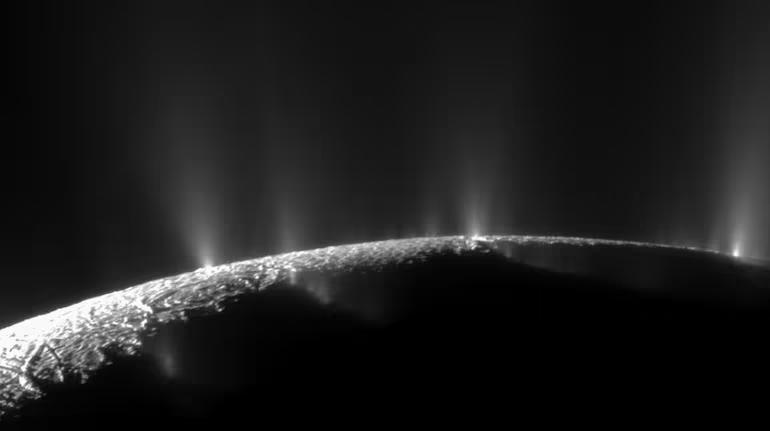
The Cassini spacecraft, which was launched in 1997 and orbited Saturn from 2004 to 2017, was designed to study the Saturnian system, including its rings, moons, and magnetic field. During its mission, Cassini made several close flybys of Enceladus, a small, icy moon that orbits Saturn. These flybys allowed the spacecraft to sample the plumes of ice and water vapor that erupt from Enceladus’s subsurface ocean. The plumes are thought to originate from a global ocean that lies beneath the moon’s icy crust, and they offer a unique window into the chemistry of this hidden ocean.
On one of its closest flybys, Cassini flew just 13 miles above the surface of Enceladus, allowing it to sample the ice grains in the active plumes. The spacecraft’s instruments detected a range of complex organic molecules, including aliphatic, cyclic, nitrogen- and oxygen-bearing compounds, as well as double-bonded molecules. These molecules are the building blocks of life and are found in all living organisms on Earth. The presence of these molecules in the plumes of Enceladus suggests that the subsurface ocean of the moon may have the necessary chemistry to support life.
The discovery of organic molecules on Enceladus is not entirely unexpected. Previous studies have suggested that the moon’s subsurface ocean may have the necessary energy and chemistry to support life. The ocean is thought to be in contact with rock, which could provide the necessary energy for chemical reactions to occur. Additionally, the presence of water and organic molecules in the plumes suggests that the ocean may have the necessary ingredients for life to emerge.
The findings from Cassini have significant implications for the search for life beyond Earth. Enceladus is now considered one of the most promising places in our solar system to search for life. The moon’s subsurface ocean is thought to be similar to the early oceans on Earth, and the presence of organic molecules suggests that the chemistry of the ocean may be similar to that of our own planet. The discovery of life on Enceladus would be a major breakthrough, as it would suggest that life is not unique to Earth and that the emergence of life may be a common process in the universe.
The detection of organic molecules on Enceladus also raises questions about the origin of life on Earth. If life can emerge on a small, icy moon like Enceladus, it is possible that life on Earth may have originated from similar chemistry. The discovery of organic molecules in the plumes of Enceladus suggests that the building blocks of life may be widespread in our solar system, and that the emergence of life may be a common process.
In conclusion, the discovery of fresh, complex organic molecules on Enceladus is a significant breakthrough in the search for life beyond Earth. The findings from Cassini suggest that the subsurface ocean of the moon may have the necessary chemistry to support life, and that Enceladus may be one of the most promising places in our solar system to search for life. The discovery of life on Enceladus would be a major breakthrough, as it would suggest that life is not unique to Earth and that the emergence of life may be a common process in the universe. As we continue to explore our solar system and beyond, we may uncover even more evidence of the potential for life to exist elsewhere in the universe.
The search for life beyond Earth is an ongoing quest that continues to captivate scientists and astronomers. The discovery of organic molecules on Enceladus is just one of many recent findings that suggest that the potential for life to exist elsewhere in our solar system is greater than we ever thought possible. As we look to the future, we can expect even more exciting discoveries that will help us to better understand the chemistry of our solar system and the potential for life to exist beyond Earth.
About the Author