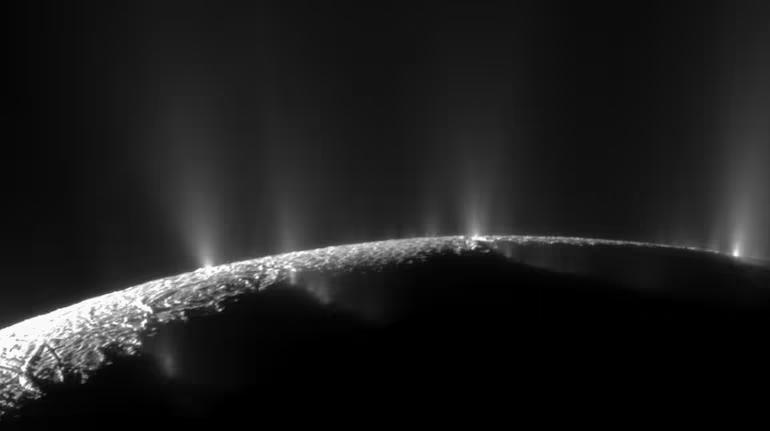
Cassini Finds Fresh Organic Molecules on Saturn’s Moon
In a groundbreaking discovery, NASA’s Cassini mission has detected fresh, complex organic molecules erupting from the subsurface ocean of Saturn’s moon Enceladus. The findings, which were obtained by the spacecraft flying just 13 miles above the surface, provide significant evidence that Enceladus could be habitable. The discovery of organic molecules, which are the building blocks of life, is a major breakthrough in the search for life beyond Earth.
The Cassini spacecraft, which was launched in 1997, has been exploring the Saturn system since 2004. During its mission, the spacecraft has made numerous flybys of Enceladus, a small, icy moon that orbits Saturn. On one of these flybys, the spacecraft flew just 13 miles above the surface of Enceladus, allowing it to sample the ice grains in the active plumes that erupt from the moon’s subsurface ocean.
The analysis of these ice grains revealed the presence of aliphatic, cyclic, nitrogen- and oxygen-bearing compounds, including double-bonded molecules. These complex organic molecules are the same type of molecules that are found in living organisms on Earth, and their presence on Enceladus suggests that the moon’s subsurface ocean may have the necessary ingredients for life.
The discovery of organic molecules on Enceladus is significant because it provides evidence that the moon’s subsurface ocean is capable of supporting life. The presence of these molecules suggests that the ocean is rich in carbon-based compounds, which are the building blocks of life. Additionally, the fact that the molecules are complex and include double-bonded molecules suggests that they may have been formed through biological processes.
The findings also suggest that Enceladus may have a hydrothermal system, similar to those found on Earth, which could provide the necessary energy and nutrients for life to exist. Hydrothermal systems, which are found in areas where hot water and minerals interact with the ocean floor, are known to support a wide range of microorganisms on Earth. If Enceladus has a similar system, it could provide a habitable environment for life to exist.
The discovery of organic molecules on Enceladus is not the first evidence that the moon may be habitable. Previous studies have suggested that Enceladus’s subsurface ocean may have the necessary conditions for life, including a stable energy source, liquid water, and a stable chemistry. The presence of organic molecules provides additional evidence that the moon may be capable of supporting life.
The Cassini mission has been instrumental in our understanding of the Saturn system and the moons that orbit the planet. The mission has provided a wealth of information about the composition, geology, and potential habitability of Enceladus and other moons in the system. The discovery of organic molecules on Enceladus is a major breakthrough in the search for life beyond Earth and provides significant evidence that the moon may be habitable.
The implications of this discovery are significant and far-reaching. If Enceladus is found to be habitable, it would provide significant evidence that life exists elsewhere in the universe. The discovery of life on another moon or planet would be a major breakthrough in the fields of astrobiology and astrophysics and would provide new insights into the origins of life in the universe.
In conclusion, the discovery of fresh, complex organic molecules on Enceladus is a significant breakthrough in the search for life beyond Earth. The presence of these molecules provides evidence that the moon’s subsurface ocean may have the necessary ingredients for life and suggests that Enceladus may be habitable. The Cassini mission has provided significant insights into the Saturn system and the moons that orbit the planet, and the discovery of organic molecules on Enceladus is a major achievement in the search for life in the universe.
About the Author