Cassini Finds Fresh Organic Molecules on Saturn’s Moon
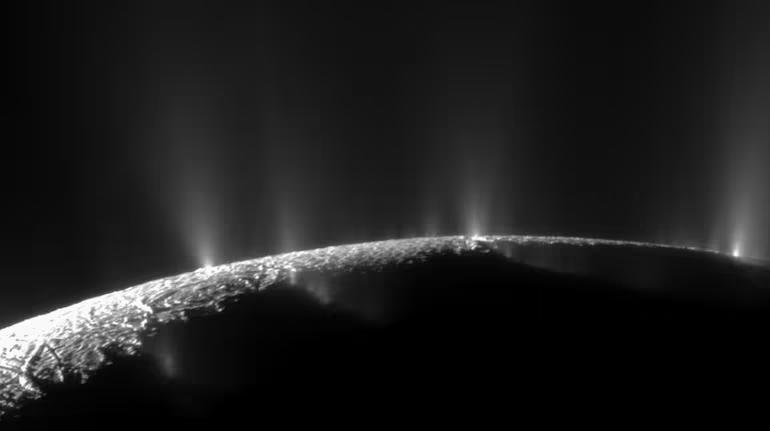
In a groundbreaking discovery, NASA’s Cassini mission has detected fresh, complex organic molecules erupting from the subsurface ocean of Saturn’s moon Enceladus. The spacecraft, flying just 13 miles above the surface, sampled ice grains in active plumes and found aliphatic, cyclic, nitrogen- and oxygen-bearing compounds, including double-bonded molecules. This finding has significant implications for the search for life beyond Earth and supports evidence that Enceladus could be habitable.
The Cassini mission, which was launched in 1997 and ended in 2017, was designed to study Saturn and its moons. During its 13-year orbit around Saturn, Cassini made numerous discoveries, including the presence of a subsurface ocean on Enceladus. The moon’s icy surface covers a global ocean, which is thought to be in contact with rock, making it a potential habitat for life.
The discovery of organic molecules on Enceladus is a significant finding because these molecules are the building blocks of life. They are complex molecules that contain carbon and hydrogen, and often include other elements such as oxygen, nitrogen, and sulfur. On Earth, organic molecules are found in all living organisms and are the basis of life as we know it.
The Cassini spacecraft was able to detect these organic molecules by flying through the plumes of ice and water vapor that erupt from Enceladus’s surface. The plumes are thought to originate from the subsurface ocean, and by analyzing the ice grains in the plumes, scientists were able to determine the composition of the molecules.
The findings, which were published in a recent study, reveal that the organic molecules on Enceladus are similar to those found on Earth. They include aliphatic and cyclic molecules, which are common in living organisms, as well as nitrogen- and oxygen-bearing compounds. The presence of double-bonded molecules is also significant, as these molecules are often found in biological systems.
The discovery of organic molecules on Enceladus has significant implications for the search for life beyond Earth. The presence of these molecules suggests that the moon’s subsurface ocean may have the necessary conditions for life to exist. The ocean is thought to be warm and chemically rich, with a possible energy source in the form of hydrothermal activity.
The finding also supports the idea that Enceladus could be a potential habitat for life. The moon’s subsurface ocean is thought to be in contact with rock, which could provide the necessary energy and nutrients for life to exist. The presence of organic molecules, which are the building blocks of life, further supports this idea.
The discovery of organic molecules on Enceladus is not the only evidence that suggests the moon could be habitable. Previous studies have found that the moon’s subsurface ocean is likely to be in contact with rock, which could provide the necessary energy and nutrients for life to exist. The ocean is also thought to be warm and chemically rich, with a possible energy source in the form of hydrothermal activity.
The Cassini mission has been a groundbreaking success, and its findings have significantly advanced our understanding of Saturn and its moons. The discovery of organic molecules on Enceladus is a major finding that has significant implications for the search for life beyond Earth. As scientists continue to study the data from the Cassini mission, they may uncover even more evidence that suggests Enceladus could be a potential habitat for life.
In conclusion, the discovery of fresh organic molecules on Enceladus is a significant finding that has major implications for the search for life beyond Earth. The presence of these molecules, which are the building blocks of life, suggests that the moon’s subsurface ocean may have the necessary conditions for life to exist. The finding supports evidence that Enceladus could be habitable and provides further evidence that the search for life beyond Earth is an exciting and ongoing area of research.
About the Author