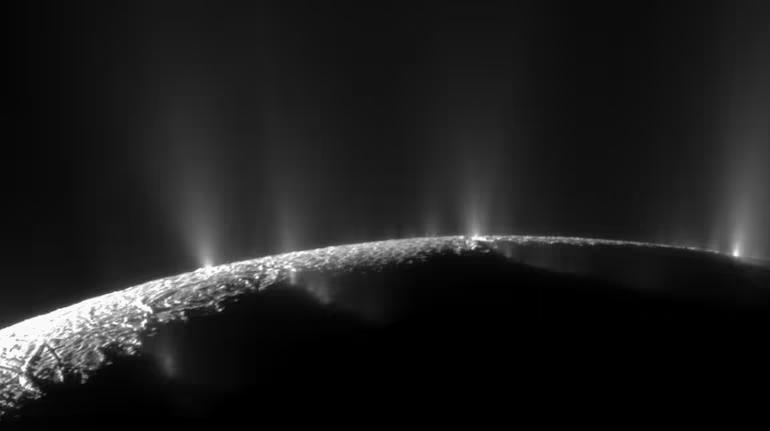
Cassini finds fresh organic molecules on Saturn’s Moon
The search for life beyond Earth has been a longstanding quest for scientists and space enthusiasts alike. While we have yet to find definitive proof of extraterrestrial life, recent discoveries have brought us closer to understanding the potential for life to exist elsewhere in our solar system. One such discovery was made by NASA’s Cassini mission, which has detected fresh, complex organic molecules erupting from the subsurface ocean of Saturn’s moon Enceladus. This finding has significant implications for the possibility of life existing on Enceladus and has shed new light on the moon’s potential habitability.
The Cassini spacecraft, which was launched in 1997 and orbited Saturn from 2004 to 2017, was equipped with a range of instruments designed to study the Saturnian system. One of these instruments, the Cosmic Dust Analyzer, was used to sample ice grains in the active plumes erupting from Enceladus’s subsurface ocean. The plumes, which are thought to originate from a global ocean beneath the moon’s icy crust, are rich in water vapor, methane, and other organic compounds. By flying just 13 miles above the surface of Enceladus, the Cassini spacecraft was able to collect and analyze the composition of these plumes in unprecedented detail.
The results of the analysis revealed a surprising array of complex organic molecules, including aliphatic, cyclic, nitrogen- and oxygen-bearing compounds, as well as double-bonded molecules. These molecules are the building blocks of life and are commonly found in living organisms on Earth. The presence of such molecules in the plumes erupting from Enceladus suggests that the moon’s subsurface ocean may have the necessary ingredients for life to exist.
The discovery of fresh organic molecules on Enceladus is significant for several reasons. Firstly, it suggests that the moon’s subsurface ocean is capable of producing complex organic molecules, which is a key requirement for life to exist. Secondly, the presence of these molecules in the plumes indicates that they are being produced in the present day, rather than being residual from some earlier era. This implies that the moon’s subsurface ocean is still active and capable of supporting chemical reactions that could potentially give rise to life.
The implications of this discovery are profound. If Enceladus is capable of producing complex organic molecules, it raises the possibility that the moon could be habitable. The presence of a subsurface ocean, combined with the necessary ingredients for life, makes Enceladus a prime target in the search for extraterrestrial life. While we have yet to find definitive proof of life on Enceladus, the discovery of fresh organic molecules brings us one step closer to understanding the potential for life to exist on this distant moon.
The Cassini mission has been instrumental in our understanding of the Saturnian system, and its discoveries have paved the way for future missions to explore Enceladus and other moons in the Saturnian system. The upcoming NASA mission, the Dragonfly mission, is scheduled to launch in 2027 and will explore Saturn’s moon Titan, as well as Enceladus. The Dragonfly mission will be equipped with a range of instruments designed to study the surface and subsurface of these moons, including a drill that will allow scientists to sample the subsurface ocean of Enceladus.
In conclusion, the discovery of fresh organic molecules on Enceladus is a significant finding that has implications for our understanding of the potential for life to exist on this distant moon. The Cassini mission has provided us with a wealth of information about the Saturnian system, and its discoveries have paved the way for future missions to explore Enceladus and other moons in the system. As we continue to explore our solar system and search for life beyond Earth, discoveries like this remind us of the awe-inspiring complexity and beauty of the universe we inhabit.
About the Author