Ancient Chinese text helps to know more about Earth’s rotation
The study of Earth’s rotation has been a longstanding area of interest for scientists, with ongoing research seeking to understand the intricacies of our planet’s movement. Recently, a team of researchers made a groundbreaking discovery using an ancient Chinese text to determine the speed of Earth’s rotation over 2,700 years ago. The findings, published in The Astrophysical Journal Letters, shed new light on the Earth’s rotation and its evolution over time.
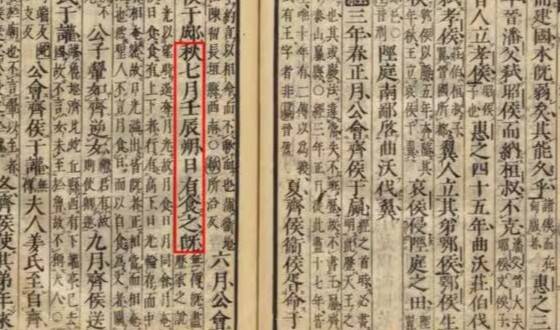
The research team focused on a solar eclipse that occurred in 709 BCE, which was documented in ancient Chinese texts. The texts described the eclipse as a total solar eclipse visible from the city of Qufu, which is located in the Shandong province of China. However, when the researchers calculated how the Sun would have appeared from Qufu during the eclipse, they found that the city was not in the path of totality. In fact, Qufu was approximately eight kilometers off the path, which meant that the total eclipse would not have been visible from the city.
This discrepancy led the researchers to re-examine the Earth’s rotation and its potential impact on the eclipse’s visibility. By studying the ancient texts and using modern astronomical software, the team was able to recreate the eclipse and determine the Earth’s rotation speed at the time. Their findings revealed that the Earth rotates slower now than it did 2,700 years ago.
The discovery has significant implications for our understanding of the Earth’s rotation and its evolution over time. The Earth’s rotation is not constant and can be influenced by various factors, including the movement of the planet’s core, the atmosphere, and the oceans. The new data provides valuable insights into the Earth’s rotation and its potential variations over the centuries.
The use of ancient texts to study astronomical events is not a new concept. Historians and astronomers have long relied on ancient records to understand celestial phenomena and their impact on human societies. However, the accuracy and reliability of these records can be a subject of debate. In this case, the ancient Chinese texts provided a unique opportunity to study the Earth’s rotation and its potential changes over time.
The research team’s findings are based on a combination of historical records, astronomical software, and mathematical modeling. By analyzing the ancient texts and using modern tools, the team was able to reconstruct the solar eclipse and determine the Earth’s rotation speed at the time. The results provide a fascinating glimpse into the Earth’s rotation and its potential variations over the centuries.
The discovery also highlights the importance of interdisciplinary research, which combines insights from astronomy, history, and mathematics. By studying ancient texts and using modern astronomical software, the researchers were able to gain new insights into the Earth’s rotation and its evolution over time. The findings demonstrate the value of collaborative research and the potential for new discoveries at the intersection of different fields.
In conclusion, the recent study on the Earth’s rotation using ancient Chinese texts provides new data on the planet’s movement and its potential variations over time. The findings, published in The Astrophysical Journal Letters, shed new light on the Earth’s rotation and its evolution over the centuries. The research highlights the importance of interdisciplinary research and the potential for new discoveries at the intersection of different fields.
The study also underscores the significance of ancient texts in understanding astronomical phenomena and their impact on human societies. The ancient Chinese texts provided a unique opportunity to study the Earth’s rotation and its potential changes over time. The findings demonstrate the value of preserving and studying historical records, which can provide valuable insights into the Earth’s movement and its potential variations over the centuries.
As we continue to explore the Earth’s rotation and its evolution over time, the new data provides a fascinating glimpse into the planet’s movement and its potential changes over the centuries. The discovery is a testament to the power of interdisciplinary research and the potential for new discoveries at the intersection of different fields.
For more information on this topic, please visit: https://indianexpress.com/article/technology/science/ancient-chinese-texts-new-clues-first-solar-eclipse-10406054/lite/
About the Author