Ancient Chinese text helps to know more about Earth’s rotation
The study of Earth’s rotation is a complex and fascinating field that has garnered significant attention from scientists and researchers over the years. Understanding the Earth’s rotation is crucial in determining the length of a day, the stability of the planet’s axis, and the distribution of heat and moisture around the globe. Recently, a team of researchers has made a groundbreaking discovery that sheds new light on the Earth’s rotation speed, thanks to an ancient Chinese text that describes a solar eclipse that occurred over 2,700 years ago.
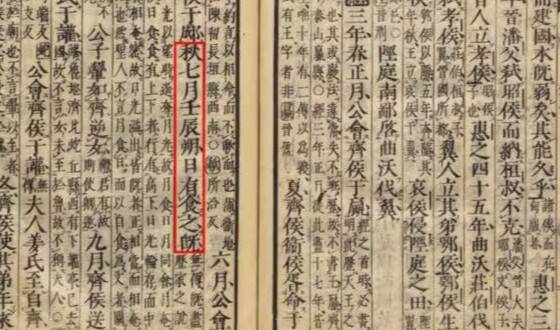
The paper, published in The Astrophysical Journal Letters, reveals that the researchers studied ancient Chinese texts that describe a solar eclipse that took place in 709 BCE. The texts, which were written by Chinese astronomers, provide a detailed account of the eclipse, including the location from which it was observed. By analyzing these texts, the researchers were able to calculate how the Sun would have appeared from the city of Qufu, which is located in the Shandong province of China.
The researchers used advanced computer simulations to recreate the solar eclipse and determine its path across the Earth’s surface. They found that the total eclipse would not have been visible from Qufu, which is a significant discovery. According to their calculations, Qufu would have been located about eight kilometers off the path of totality, which means that the city would have experienced a partial eclipse rather than a total one.
This discovery has significant implications for our understanding of the Earth’s rotation. By analyzing the ancient Chinese texts and recreating the solar eclipse, the researchers were able to determine that the Earth rotates slower now than it did 2,700 years ago. This is a remarkable finding, as it provides new insights into the Earth’s rotational history and the factors that influence its rotation.
The study of ancient astronomical events like solar eclipses can provide valuable information about the Earth’s rotation and its changes over time. By analyzing these events, researchers can gain a better understanding of the Earth’s rotational history and the factors that influence its rotation. This knowledge can also be used to improve our understanding of the Earth’s climate and the distribution of heat and moisture around the globe.
The use of ancient Chinese texts in this study highlights the importance of historical records in scientific research. The ancient Chinese astronomers who wrote these texts were meticulous observers of the night sky, and their records provide a unique window into the past. By analyzing these records, researchers can gain a better understanding of the Earth’s rotational history and the factors that influence its rotation.
The discovery that the Earth rotates slower now than it did 2,700 years ago is a significant finding that has important implications for our understanding of the Earth’s climate and the distribution of heat and moisture around the globe. The Earth’s rotation plays a critical role in determining the length of a day, the stability of the planet’s axis, and the distribution of heat and moisture around the globe. Changes in the Earth’s rotation can have significant effects on the planet’s climate, and understanding these changes is crucial for predicting future climate patterns.
In conclusion, the study of ancient Chinese texts has provided new insights into the Earth’s rotation and its changes over time. The discovery that the Earth rotates slower now than it did 2,700 years ago is a significant finding that has important implications for our understanding of the Earth’s climate and the distribution of heat and moisture around the globe. The use of historical records in scientific research highlights the importance of preserving and analyzing these records, as they can provide valuable information about the Earth’s rotational history and the factors that influence its rotation.
The study of the Earth’s rotation is an ongoing field of research, and new discoveries are continually being made. The use of advanced computer simulations and historical records has enabled researchers to gain a better understanding of the Earth’s rotational history and the factors that influence its rotation. As our understanding of the Earth’s rotation continues to evolve, we can expect to gain new insights into the planet’s climate and the distribution of heat and moisture around the globe.
In the future, researchers may use similar techniques to study other ancient astronomical events, such as lunar eclipses and planetary alignments. By analyzing these events, researchers can gain a better understanding of the Earth’s rotational history and the factors that influence its rotation. This knowledge can be used to improve our understanding of the Earth’s climate and the distribution of heat and moisture around the globe, and to predict future climate patterns.
Overall, the study of ancient Chinese texts has provided new insights into the Earth’s rotation and its changes over time. The discovery that the Earth rotates slower now than it did 2,700 years ago is a significant finding that has important implications for our understanding of the Earth’s climate and the distribution of heat and moisture around the globe. As our understanding of the Earth’s rotation continues to evolve, we can expect to gain new insights into the planet’s climate and the distribution of heat and moisture around the globe.
About the Author