Ancient Chinese text helps to know more about Earth’s rotation
The study of Earth’s rotation has been a topic of interest for scientists and researchers for centuries. Understanding the speed and patterns of our planet’s rotation is crucial for various fields, including astronomy, geology, and climate science. Recently, a team of researchers has made a groundbreaking discovery using ancient Chinese texts to determine the speed of Earth’s rotation over 2,700 years ago. This finding, published in The Astrophysical Journal Letters, provides new insights into the history of our planet’s rotation and has significant implications for our understanding of the Earth’s dynamics.
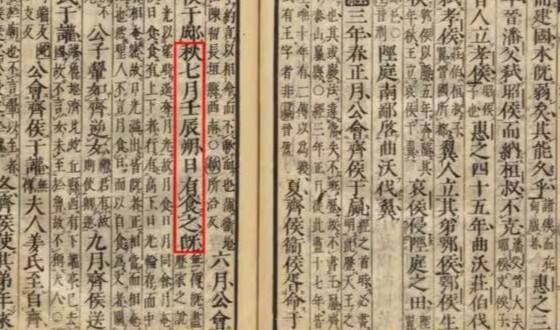
The researchers focused on an ancient Chinese text that described a solar eclipse that occurred in 709 BCE. This text, which is part of the Chinese historical records, provides a detailed account of the eclipse, including the location from which it was observed. The team used this information to calculate how the Sun would have appeared from the city of Qufu, which is believed to be the location from which the eclipse was observed. By simulating the eclipse using modern astronomical software, the researchers found that the total eclipse would not have been visible from Qufu, but rather would have appeared as a partial eclipse.
This discovery led the researchers to conclude that the city of Qufu was actually located about eight kilometers away from the path of totality, which is the region where the eclipse would have been visible in its entirety. This discrepancy between the observed and calculated locations of the eclipse suggests that the Earth’s rotation has slowed down over the past 2,700 years. The researchers estimate that the length of a day on Earth has increased by about 1.8 milliseconds over this period, which may seem like a small change, but it has significant implications for our understanding of the Earth’s dynamics.
The study of ancient eclipses is a fascinating field that has garnered significant attention in recent years. By analyzing ancient texts and records, researchers can gain insights into the Earth’s rotation, the Moon’s orbit, and the Sun’s behavior over thousands of years. This field of study, known as “eclipse astronomy,” has the potential to reveal new information about the Earth’s history and the behavior of our planet’s celestial companions.
The use of ancient Chinese texts in this study highlights the importance of interdisciplinary research and the value of combining modern scientific techniques with historical records. The ancient Chinese texts used in this study are part of a rich cultural heritage that has been preserved for centuries, and their analysis has provided new insights into the Earth’s rotation and the behavior of our planet over thousands of years.
The discovery that the Earth’s rotation has slowed down over the past 2,700 years has significant implications for our understanding of the Earth’s dynamics. The length of a day on Earth is determined by the planet’s rotation, and changes in the rotation rate can affect the length of a day and the stability of the Earth’s axis. This, in turn, can have significant effects on the planet’s climate, ocean currents, and the behavior of the Earth’s magnetic field.
The study of the Earth’s rotation is an ongoing field of research, and new discoveries are being made regularly. The use of ancient Chinese texts and other historical records has the potential to reveal new information about the Earth’s history and the behavior of our planet over thousands of years. As researchers continue to analyze and interpret these records, we can expect to gain a deeper understanding of the Earth’s dynamics and the complex processes that shape our planet.
In conclusion, the study of ancient Chinese texts has provided new insights into the Earth’s rotation over the past 2,700 years. The discovery that the Earth’s rotation has slowed down over this period has significant implications for our understanding of the Earth’s dynamics and the behavior of our planet. As researchers continue to analyze and interpret historical records, we can expect to gain a deeper understanding of the Earth’s history and the complex processes that shape our planet.
About the Author