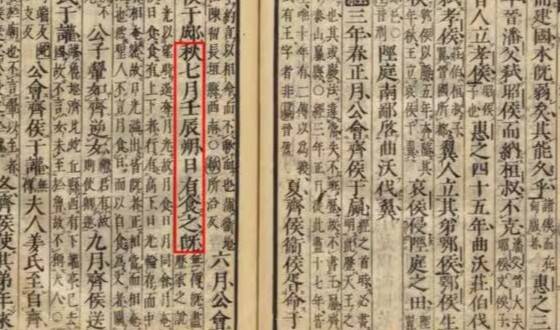
Ancient Chinese text helps to know more about Earth’s rotation
The study of the Earth’s rotation has been a subject of interest for scientists and astronomers for centuries. Understanding the Earth’s rotation is crucial in determining the length of a day, the timing of the tides, and the stability of the planet’s climate. Recently, a team of researchers has made a groundbreaking discovery using an ancient Chinese text to determine the speed of the Earth’s rotation. In a paper published in The Astrophysical Journal Letters, the researchers used ancient Chinese texts describing a solar eclipse in 709 BCE to calculate how the Sun would have appeared from the city of Qufu. The findings of this study have significant implications for our understanding of the Earth’s rotation and its changes over time.
The ancient Chinese text used in the study is a historical record of a solar eclipse that occurred on April 21, 709 BCE. The text describes the eclipse as a total solar eclipse, which is an event where the Moon passes directly between the Earth and the Sun, blocking the Sun’s light and casting a shadow on the Earth. The researchers used this text to calculate the path of the eclipse and determine how it would have appeared from the city of Qufu, which is located in the Shandong province of China.
Using advanced computer simulations, the researchers recreated the eclipse as it would have appeared from Qufu. They found that the total eclipse would not have been visible from the city, contradicting the ancient text’s description. However, by adjusting the Earth’s rotation speed, the researchers were able to recreate the eclipse as a total solar eclipse visible from Qufu. This placed the city about eight kilometers off from its actual location, indicating that the Earth’s rotation speed has slowed down over the past 2,700 years.
The discovery that the Earth’s rotation speed has slowed down over time is not surprising. It is well known that the Earth’s rotation is slowing down due to the tidal interactions with the Moon. The Moon’s gravity causes the Earth’s oceans to bulge, which in turn slows down the Earth’s rotation. This effect is very small, but it adds up over time, resulting in a longer day. The researchers’ findings confirm this theory and provide new evidence for the slowing down of the Earth’s rotation.
The use of ancient Chinese texts to study the Earth’s rotation is a novel approach that has yielded significant results. The ancient Chinese were meticulous record-keepers, and their texts provide a wealth of information about astronomical events, including solar eclipses. By studying these texts, researchers can gain insights into the Earth’s rotation and its changes over time. This approach has the potential to provide new data on the Earth’s rotation speed and its variations over the past few thousand years.
The implications of this study are significant. Understanding the Earth’s rotation speed and its changes over time is crucial for a range of applications, from astronomy to geology. The Earth’s rotation speed affects the length of a day, the timing of the tides, and the stability of the planet’s climate. By studying the Earth’s rotation, researchers can gain insights into the planet’s internal dynamics and its interactions with the Moon and the Sun.
In conclusion, the study of ancient Chinese texts has provided new clues about the Earth’s rotation speed. By using advanced computer simulations to recreate a solar eclipse described in an ancient text, researchers have found that the Earth’s rotation speed has slowed down over the past 2,700 years. This discovery has significant implications for our understanding of the Earth’s rotation and its changes over time. The use of ancient texts to study the Earth’s rotation is a novel approach that has the potential to provide new data on the Earth’s rotation speed and its variations over the past few thousand years.
The study highlights the importance of interdisciplinary research, combining astronomy, history, and computer science to gain new insights into the Earth’s rotation. The findings of this study demonstrate the value of using ancient texts to study the Earth’s rotation and its changes over time. As researchers continue to study the Earth’s rotation, they may uncover new clues about the planet’s internal dynamics and its interactions with the Moon and the Sun.
The discovery that the Earth’s rotation speed has slowed down over time is a reminder of the dynamic nature of our planet. The Earth’s rotation is not constant, but is affected by a range of factors, including the tidal interactions with the Moon. By studying the Earth’s rotation, researchers can gain insights into the planet’s internal dynamics and its interactions with the Moon and the Sun.
The study of the Earth’s rotation is an ongoing area of research, with new discoveries and insights being made regularly. The use of ancient Chinese texts to study the Earth’s rotation is a new and exciting area of research, with the potential to provide new data on the Earth’s rotation speed and its variations over the past few thousand years. As researchers continue to study the Earth’s rotation, they may uncover new clues about the planet’s internal dynamics and its interactions with the Moon and the Sun.
About the Author