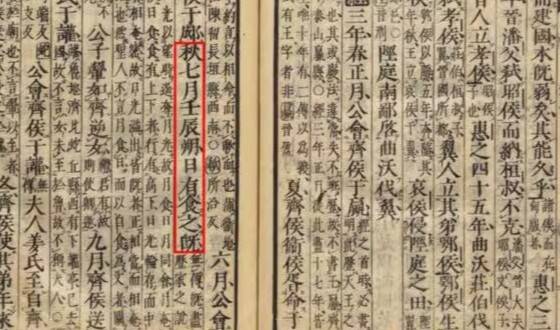
Ancient Chinese text helps to know more about Earth’s rotation
The study of the Earth’s rotation has long been a fascinating topic for scientists and researchers. Understanding the intricacies of our planet’s movement is crucial for various fields, including astronomy, geology, and climatology. Recently, a team of researchers has made a groundbreaking discovery that sheds new light on the Earth’s rotation speed, using an ancient Chinese text as their primary source. In a paper published in The Astrophysical Journal Letters, the researchers reveal that the Earth’s rotation has slowed down over the past 2,700 years, providing new insights into the planet’s history.
The research team focused on an ancient Chinese text that describes a solar eclipse that occurred in 709 BCE. The text, which is part of the Chinese historical records, provides a detailed account of the eclipse, including the location from which it was observed. The researchers used this information to calculate how the Sun would have appeared from the city of Qufu, which is believed to be the location from which the eclipse was observed. By using advanced astronomical software, the team was able to recreate the eclipse and determine its visibility from Qufu.
The results of the study were surprising. According to the calculations, the total eclipse would not have been visible from Qufu, which suggests that the city was not in the path of totality. However, the ancient text clearly states that the eclipse was observed from Qufu, which led the researchers to conclude that the city must have been located about eight kilometers off from the path of totality. This discrepancy can be explained by the fact that the Earth’s rotation has slowed down over time, causing the planet’s rotation to shift.
The researchers used this information to calculate the Earth’s rotation speed 2,700 years ago and compared it to the current rotation speed. The results show that the Earth’s rotation has indeed slowed down over the past 2,700 years, which is consistent with previous theories. The study provides new data on the Earth’s rotation speed, which can be used to refine our understanding of the planet’s history and evolution.
The use of ancient texts to study the Earth’s rotation is not new, but this particular study is significant because it provides a unique insight into the planet’s movement over a long period. The ancient Chinese text used in the study is one of the earliest recorded solar eclipses, and its description provides valuable information about the event. The fact that the text was written over 2,700 years ago makes it an invaluable resource for scientists, who can use it to study the Earth’s rotation and its effects on the planet’s climate and geology.
The study also highlights the importance of interdisciplinary research, which involves collaboration between scientists from different fields. In this case, the researchers used a combination of astronomy, history, and geology to study the Earth’s rotation. By combining their expertise, the team was able to gain a deeper understanding of the planet’s movement and its effects on the environment.
The discovery that the Earth’s rotation has slowed down over the past 2,700 years has significant implications for our understanding of the planet’s history. It suggests that the Earth’s rotation has not been constant over time, but has been affected by various factors, including the planet’s interaction with the Moon and the Sun. This knowledge can be used to refine our understanding of the Earth’s climate and geology, which is essential for predicting future changes and mitigating their effects.
In conclusion, the study of the ancient Chinese text has provided new insights into the Earth’s rotation speed, which is a significant discovery for the scientific community. The use of ancient texts to study the Earth’s rotation is a powerful tool, which can provide valuable information about the planet’s history and evolution. As scientists continue to study the Earth’s rotation, they may uncover more secrets about the planet’s movement and its effects on the environment. The discovery that the Earth’s rotation has slowed down over the past 2,700 years is a reminder of the complex and dynamic nature of our planet, and the need for continued research and exploration.
About the Author