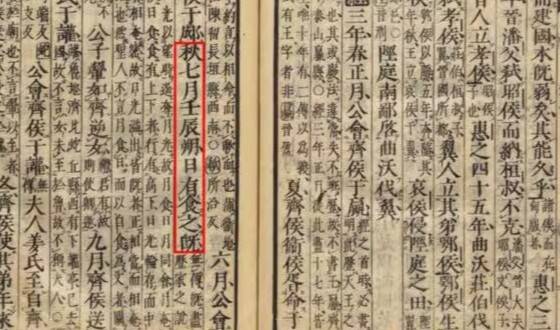
Ancient Chinese text helps to know more about Earth’s rotation
The study of Earth’s rotation has long been a subject of interest for scientists and researchers. Understanding the rotation of our planet is crucial in grasping the fundamental principles of astronomy and the behavior of our solar system. Recently, a team of researchers has made a groundbreaking discovery that sheds new light on Earth’s rotation speed, using an unlikely source: ancient Chinese texts. A paper published in The Astrophysical Journal Letters presents new data on Earth’s rotation speed, which has significant implications for our understanding of the planet’s behavior over time.
The researchers focused on an ancient Chinese text that describes a solar eclipse that occurred in 709 BCE. This event was recorded by Chinese astronomers, who meticulously documented the celestial phenomenon. By studying this text, the researchers aimed to calculate how the Sun would have appeared from the city of Qufu, which is located in the Shandong province of China. Qufu is significant because it is the birthplace of Confucius, and the ancient text provides valuable information about the eclipse as seen from this location.
Using advanced computer simulations, the researchers recreated the solar eclipse as it would have appeared from Qufu city. They found that the total eclipse would not have been visible from this location, contrary to what was previously believed. This discovery is crucial because it allows the researchers to calculate the Earth’s rotation speed at that time. By analyzing the ancient text and simulating the eclipse, the researchers were able to determine that Qufu city would have been approximately eight kilometers off from the path of totality, which is the area where the eclipse is total.
This finding has significant implications for our understanding of Earth’s rotation. The researchers conclude that the Earth rotates slower now than it did 2,700 years ago. This is a remarkable discovery, as it provides new insights into the planet’s behavior over time. The study suggests that the length of a day on Earth has increased by about 1.8 milliseconds over the past 2,700 years. While this may seem like a small change, it is a significant finding that can help scientists better understand the Earth’s rotation and its effects on our planet.
The use of ancient Chinese texts in this study highlights the importance of historical records in scientific research. By analyzing these texts, researchers can gain valuable insights into the past behavior of our planet and the universe. The study demonstrates the power of interdisciplinary research, combining astronomy, history, and computer simulations to make new discoveries.
The discovery also has significant implications for our understanding of the Earth’s interior and the planet’s magnetic field. The slowing down of the Earth’s rotation is thought to be caused by the tidal interactions between the Earth and the Moon. As the Moon orbits the Earth, it causes the planet’s rotation to slow down, resulting in longer days. This process has been occurring over billions of years, and the new study provides valuable insights into the Earth’s rotation speed over time.
In conclusion, the study of ancient Chinese texts has provided new clues about the Earth’s rotation speed. By analyzing the description of a solar eclipse in 709 BCE, researchers have been able to calculate the Earth’s rotation speed at that time and compare it to the present day. The finding that the Earth rotates slower now than it did 2,700 years ago is a significant discovery that can help scientists better understand the planet’s behavior over time. The study demonstrates the importance of interdisciplinary research and the power of combining historical records with advanced computer simulations to make new discoveries.
As scientists continue to study the Earth’s rotation and its effects on our planet, this new discovery will undoubtedly play a significant role in shaping our understanding of the universe. The use of ancient texts in scientific research is a testament to the importance of preserving historical records and the value of interdisciplinary research.
About the Author