Ancient Chinese text helps to know more about Earth’s rotation
The study of Earth’s rotation has been a fascinating topic for scientists and researchers for centuries. Understanding the intricacies of our planet’s movement has significant implications for various fields, including astronomy, geology, and climate science. Recently, a team of researchers has made a groundbreaking discovery by analyzing ancient Chinese texts that describe a solar eclipse in 709 BCE. This study, published in The Astrophysical Journal Letters, provides new insights into Earth’s rotation speed and sheds light on the planet’s history.
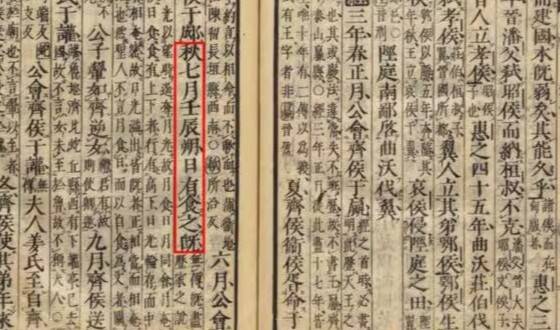
The ancient Chinese text in question describes a solar eclipse that occurred on April 21, 709 BCE, during the reign of the Zhou Dynasty. The text, which is part of the “Records of the Grand Historian” by Sima Qian, provides detailed information about the eclipse, including the location from which it was observed. The researchers, who studied this text, were particularly interested in the fact that the eclipse was described as a total solar eclipse, which is a rare and spectacular event.
To better understand the significance of this ancient text, the researchers used computer simulations to calculate how the Sun would have appeared from the city of Qufu, which is believed to be the location from which the eclipse was observed. Qufu is a city in the Shandong Province of China and is considered to be the birthplace of Confucius. By analyzing the ancient text and using advanced computational models, the researchers were able to recreate the eclipse as it would have appeared from Qufu.
However, when the researchers ran their simulations, they found that the total eclipse would not have been visible from Qufu. In fact, the city would have been located about eight kilometers outside the path of totality, which is the region from which the eclipse would have appeared as a total solar eclipse. This discrepancy between the ancient text and the computer simulations suggests that the Earth’s rotation has slowed down over the past 2,700 years.
The researchers’ conclusion is based on the fact that the Earth’s rotation is not constant and has been slowing down over time due to the gravitational interactions with the Moon. This slowing down of the Earth’s rotation results in an increase in the length of a day by about 1.78 milliseconds per century. By analyzing the ancient Chinese text and using computer simulations, the researchers were able to quantify this effect and provide new insights into the Earth’s rotation speed.
The implications of this study are significant, as they provide a new way to understand the Earth’s rotation and its history. By analyzing ancient texts and using advanced computational models, researchers can gain insights into the planet’s movement and its interactions with other celestial bodies. This study also highlights the importance of interdisciplinary research, which combines astronomy, history, and computer science to shed light on the Earth’s rotation.
The discovery of the Earth’s slowing rotation has significant implications for various fields, including astronomy and geology. For example, understanding the Earth’s rotation is crucial for predicting the orbits of celestial bodies and for understanding the planet’s climate. The study of the Earth’s rotation also has significant implications for our understanding of the planet’s geological history, including the formation of the Earth’s crust and the movement of tectonic plates.
In conclusion, the study of ancient Chinese texts has provided new insights into the Earth’s rotation speed and its history. By analyzing the description of a solar eclipse in 709 BCE, researchers were able to calculate how the Sun would have appeared from Qufu city and found that the total eclipse would not have been visible from that location. This discrepancy suggests that the Earth’s rotation has slowed down over the past 2,700 years, providing new clues about the planet’s movement and its interactions with other celestial bodies.
The use of ancient texts and computer simulations has opened up new avenues for research and has provided a new way to understand the Earth’s rotation. This study highlights the importance of interdisciplinary research and the significance of analyzing ancient texts in the context of modern science. As researchers continue to study the Earth’s rotation and its history, we can expect to gain new insights into the planet’s movement and its place in the universe.
The study of the Earth’s rotation is an ongoing field of research, and new discoveries are continually being made. The analysis of ancient Chinese texts is just one example of how researchers are using innovative methods to understand the Earth’s movement. As we continue to explore the planet and its history, we can expect to uncover new and exciting discoveries that will shed light on the Earth’s rotation and its significance in the universe.
About the Author