Ancient Chinese text helps to know more about Earth’s rotation
The study of Earth’s rotation has been a topic of interest for scientists and researchers for centuries. Understanding the rotation of our planet is crucial in determining the length of a day, which has significant implications for our daily lives, from coordinating time zones to predicting weather patterns. Recently, a team of researchers has made a groundbreaking discovery that sheds new light on Earth’s rotation speed, using an unlikely source: ancient Chinese texts.
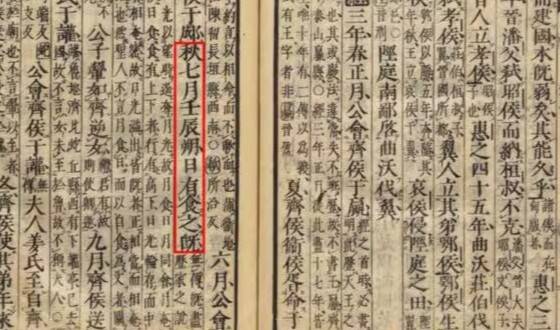
A paper published in The Astrophysical Journal Letters presents new data on Earth’s rotation speed, which was calculated by analyzing ancient Chinese texts describing a solar eclipse that occurred in 709 BCE. The researchers studied these texts to determine how the Sun would have appeared from the city of Qufu, located in the Shandong province of China. By doing so, they were able to calculate the rotation speed of Earth at that time and compare it to the current rotation speed.
The ancient Chinese texts described a total solar eclipse that was supposed to be visible from Qufu. However, the researchers found that the total eclipse would not have been visible from Qufu, placing the city about eight kilometers off from the path of totality. This discrepancy led the researchers to conclude that Earth rotates slower now than it did 2,700 years ago.
This discovery has significant implications for our understanding of Earth’s rotation. The length of a day on Earth is not constant and has been slowing down over time due to the gravitational interactions with the Moon. This slowdown is caused by the tidal interactions between the two bodies, which transfer angular momentum from the Earth to the Moon. As a result, the length of a day on Earth increases by about 1.78 seconds every century.
The researchers’ findings suggest that the rotation speed of Earth has been slowing down over the past 2,700 years. This slowdown is consistent with the expected effects of tidal interactions between the Earth and the Moon. The study provides new insights into the Earth-Moon system and the long-term variations in Earth’s rotation.
The use of ancient Chinese texts to study Earth’s rotation is a remarkable example of how historical records can be used to inform our understanding of the natural world. The ancient Chinese were meticulous in recording astronomical events, including solar eclipses, which provides a unique opportunity for scientists to study the past behavior of the Earth-Moon system.
The study highlights the importance of interdisciplinary research, combining astronomy, history, and geophysics to gain a deeper understanding of our planet. By analyzing ancient texts and using modern computational methods, the researchers were able to reconstruct the past behavior of the Earth-Moon system and gain new insights into the rotation speed of our planet.
The discovery also underscores the significance of preserving historical records and cultural heritage. The ancient Chinese texts used in this study are a testament to the advanced astronomical knowledge of the ancient Chinese civilization. The preservation of these texts has allowed scientists to study the past behavior of the Earth-Moon system and gain new insights into the natural world.
In conclusion, the study of ancient Chinese texts has provided new clues about Earth’s rotation speed, revealing that our planet rotates slower now than it did 2,700 years ago. This discovery has significant implications for our understanding of the Earth-Moon system and the long-term variations in Earth’s rotation. The use of historical records to inform our understanding of the natural world is a powerful tool, and this study demonstrates the importance of interdisciplinary research and the preservation of cultural heritage.
About the Author