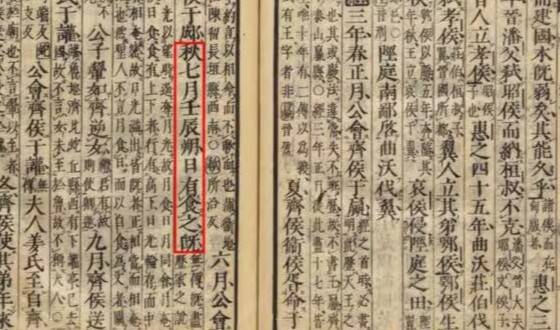
Ancient Chinese text helps to know more about Earth’s rotation
The study of Earth’s rotation has been a topic of interest for scientists and astronomers for centuries. Understanding the rotation of our planet is crucial for various fields, including astronomy, geology, and climate science. Recently, a paper published in The Astrophysical Journal Letters has shed new light on the rotation speed of Earth, thanks to the analysis of an ancient Chinese text describing a solar eclipse that occurred in 709 BCE. The research has provided new data on the rotation speed of Earth, revealing that our planet rotates slower now than it did 2,700 years ago.
The ancient Chinese text, which describes a solar eclipse that took place on April 21, 709 BCE, was studied by researchers who were determined to calculate how the Sun would have appeared from the city of Qufu, which is located in the Shandong province of China. Qufu is notable for being the birthplace of Confucius, a famous Chinese philosopher and politician. The text, which is part of the historical records of the Spring and Autumn period, provides a detailed description of the solar eclipse, including the time of day and the direction of the Sun.
By analyzing the ancient text and using modern astronomical software, the researchers were able to calculate the position of the Sun, Moon, and Earth during the solar eclipse. They found that the total eclipse would not have been visible from Qufu, which was unexpected. According to their calculations, Qufu would have been located about eight kilometers away from the path of totality, which is the region where the total eclipse is visible.
This discovery led the researchers to conclude that the Earth’s rotation has slowed down over the past 2,700 years. The rotation speed of Earth is not constant and has been affected by various factors, including the gravitational pull of the Moon and the movement of the planet’s core. The researchers’ findings suggest that the Earth’s rotation has decreased by about 1.8 milliseconds per century, which may seem like a small change, but it adds up over time.
The study of ancient astronomical events, such as solar eclipses, can provide valuable insights into the rotation speed of Earth. By analyzing these events, researchers can reconstruct the Earth’s rotation over time and gain a better understanding of the planet’s internal dynamics. The use of ancient Chinese texts, such as the one studied in this research, can provide a unique window into the past, allowing scientists to study the Earth’s rotation over long periods of time.
The findings of this research have significant implications for our understanding of the Earth’s rotation and its impact on the planet’s climate and geology. The slowing down of the Earth’s rotation can affect the length of the day, the stability of the planet’s axis, and the movement of the tectonic plates. Understanding these changes can help scientists better predict the Earth’s behavior and prepare for potential natural disasters, such as earthquakes and volcanic eruptions.
In addition to its scientific significance, this research highlights the importance of preserving and studying ancient texts. The ancient Chinese text that was analyzed in this study is a valuable resource that provides a glimpse into the past, allowing scientists to reconstruct the Earth’s rotation over time. The study of ancient texts can also provide insights into the cultural and historical context of ancient civilizations, such as the Chinese empire during the Spring and Autumn period.
In conclusion, the study of an ancient Chinese text has provided new data on the rotation speed of Earth, revealing that our planet rotates slower now than it did 2,700 years ago. The research, which was published in The Astrophysical Journal Letters, has significant implications for our understanding of the Earth’s rotation and its impact on the planet’s climate and geology. The use of ancient texts, such as the one studied in this research, can provide a unique window into the past, allowing scientists to study the Earth’s rotation over long periods of time.
The study of the Earth’s rotation is an ongoing field of research, and scientists will continue to explore new ways to understand the planet’s internal dynamics. The analysis of ancient astronomical events, such as solar eclipses, will remain an important tool for reconstructing the Earth’s rotation over time. As scientists continue to study the Earth’s rotation, they will gain a better understanding of the planet’s behavior and be able to predict potential natural disasters.
The discovery of the Earth’s slowing rotation is a significant finding that highlights the importance of continued research into the planet’s internal dynamics. By studying the Earth’s rotation and its impact on the planet’s climate and geology, scientists can gain a better understanding of the complex systems that govern our planet. The use of ancient texts, such as the one studied in this research, will remain an important tool for understanding the Earth’s rotation over long periods of time.
About the Author