Ancient Chinese text helps to know more about Earth’s rotation
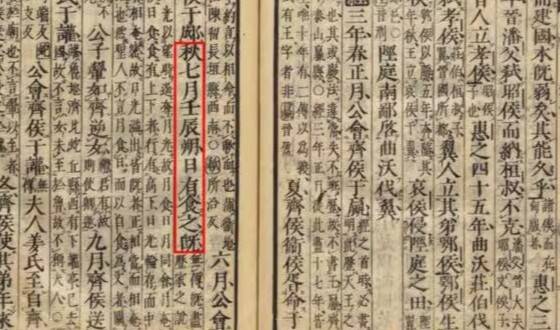
The study of the Earth’s rotation is a complex and fascinating field that has garnered significant attention from scientists and researchers. Recently, a paper published in The Astrophysical Journal Letters has shed new light on the Earth’s rotation speed, thanks to the careful analysis of an ancient Chinese text describing a solar eclipse that occurred in 709 BCE. This remarkable discovery has provided new insights into the Earth’s rotational velocity, revealing that our planet rotates slower now than it did 2,700 years ago.
The ancient Chinese text in question is a historical record of a solar eclipse that took place on April 21, 709 BCE, during the Spring and Autumn period of Chinese history. The text describes the eclipse as a total solar eclipse, which was observed from the city of Qufu, the capital of the state of Lu. The researchers, intrigued by this ancient account, decided to investigate further and calculate how the Sun would have appeared from Qufu city during the eclipse.
Using advanced astronomical software, the researchers simulated the solar eclipse of 709 BCE and calculated the path of totality, which is the region on the Earth’s surface where the eclipse is visible in its entirety. To their surprise, they found that the total eclipse would not have been visible from Qufu city, but rather from a location about eight kilometers to the east. This discrepancy suggests that the Earth’s rotation has slowed down over the past 2,700 years, causing the planet’s rotational axis to shift slightly.
The researchers’ findings have significant implications for our understanding of the Earth’s rotation and its variations over time. The Earth’s rotation is not a constant phenomenon, but rather it is influenced by various factors such as the gravitational pull of the Moon and the Sun, the movement of the Earth’s core, and the distribution of mass around the planet. These factors can cause the Earth’s rotation to slow down or speed up, resulting in changes to the length of a day.
The discovery of the ancient Chinese text and its analysis has provided a unique opportunity for scientists to study the Earth’s rotation over a long period. By combining historical records with modern astronomical techniques, researchers can gain a better understanding of the Earth’s rotational dynamics and its evolution over time. This knowledge can also be used to improve our predictions of the Earth’s rotation and its impact on various geological and astronomical phenomena, such as the timing of eclipses and the movement of the Earth’s tectonic plates.
The use of ancient texts to study the Earth’s rotation is not a new concept, but it is a rapidly evolving field that has gained significant attention in recent years. Historians and astronomers have long recognized the value of ancient records in understanding the Earth’s rotational dynamics, and several studies have been conducted on the subject. However, the analysis of the ancient Chinese text describing the solar eclipse of 709 BCE is a significant breakthrough, as it provides a precise and reliable record of the Earth’s rotation during a specific period in the past.
The study of the Earth’s rotation is a complex and multidisciplinary field that requires the collaboration of scientists from various backgrounds, including astronomy, geology, and history. The analysis of ancient texts, such as the one describing the solar eclipse of 709 BCE, is a crucial part of this research, as it provides a unique window into the Earth’s rotational dynamics over long periods. By combining historical records with modern astronomical techniques, researchers can gain a deeper understanding of the Earth’s rotation and its variations over time, which can have significant implications for our understanding of the Earth’s climate, geology, and astronomical phenomena.
In conclusion, the study of the ancient Chinese text describing the solar eclipse of 709 BCE has provided new insights into the Earth’s rotation speed, revealing that our planet rotates slower now than it did 2,700 years ago. This discovery is a significant breakthrough in the field of astronomy and has important implications for our understanding of the Earth’s rotational dynamics and its evolution over time. The use of ancient texts to study the Earth’s rotation is a rapidly evolving field that holds great promise for advancing our knowledge of the Earth’s history and its place in the universe.
About the Author