Ancient Chinese text helps to know more about Earth’s rotation
The study of ancient texts has long been a valuable resource for understanding historical events, cultural practices, and even scientific phenomena. Recently, a team of researchers has made a fascinating discovery by analyzing an ancient Chinese text that describes a solar eclipse in 709 BCE. The findings, published in The Astrophysical Journal Letters, provide new insights into the Earth’s rotation speed, revealing that our planet rotates slower now than it did 2,700 years ago.
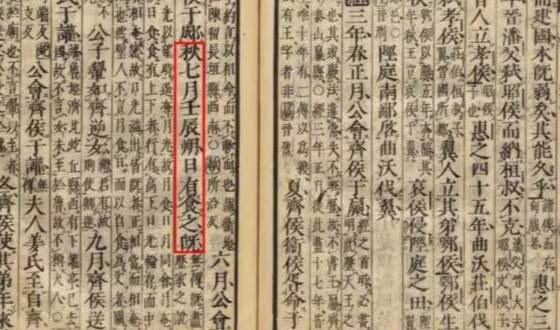
The ancient Chinese text in question is a record of a solar eclipse that occurred on April 21, 709 BCE, during the reign of King Zhuang of the Chinese state of Chu. The text describes the eclipse as a total solar eclipse, which is an event where the Moon passes directly between the Earth and the Sun, blocking the Sun’s light and revealing the Sun’s corona. However, the researchers found that the text’s description of the eclipse’s visibility from the city of Qufu, in what is now Shandong Province, China, was inconsistent with modern calculations of the eclipse’s path.
To investigate this discrepancy, the researchers used computer simulations to calculate how the Sun would have appeared from Qufu city during the eclipse. They found that, according to their calculations, the total eclipse would not have been visible from Qufu, contradicting the ancient text’s description. This led the researchers to conclude that Qufu must have been located about eight kilometers off from its current position, which would have placed it within the path of totality.
But how does this relate to the Earth’s rotation speed? The key lies in the fact that the Earth’s rotation is not constant, but rather slows down over time due to the gravitational interactions with the Moon. This means that the length of a day on Earth increases by about 1.78 milliseconds every century. By analyzing the ancient text’s description of the eclipse and calculating the position of Qufu at the time, the researchers were able to infer the Earth’s rotation speed 2,700 years ago.
The findings suggest that the Earth’s rotation speed has decreased over the past 2,700 years, which is consistent with our current understanding of the Earth-Moon system’s dynamics. This decrease in rotation speed means that the length of a day on Earth has increased over time, which has significant implications for our understanding of the Earth’s geological and astronomical history.
The study’s lead author noted that the ancient Chinese text provided a unique opportunity to test the Earth’s rotation speed in the distant past. “The ancient Chinese text is a valuable resource for understanding the Earth’s rotation speed, as it provides a snapshot of the Earth’s rotation at a specific point in time,” the author said. “By analyzing the text and using computer simulations, we were able to infer the Earth’s rotation speed 2,700 years ago and compare it to the present day.”
The discovery has significant implications for various fields of study, including astronomy, geology, and climate science. For example, understanding the Earth’s rotation speed over time can help scientists better understand the planet’s geological history, including the formation of the Earth’s crust and the movement of tectonic plates. Additionally, changes in the Earth’s rotation speed can affect the planet’s climate, as they can influence the distribution of heat around the globe.
The study also highlights the importance of interdisciplinary research, combining insights from astronomy, history, and computer science to gain a deeper understanding of the Earth’s dynamics. By analyzing ancient texts and using modern computational tools, researchers can uncover new clues about the Earth’s past and gain a better understanding of the complex processes that shape our planet.
In conclusion, the study of ancient Chinese texts has provided a fascinating glimpse into the Earth’s rotation speed in the distant past. The findings, published in The Astrophysical Journal Letters, demonstrate that the Earth’s rotation speed has decreased over the past 2,700 years, consistent with our current understanding of the Earth-Moon system’s dynamics. As scientists continue to explore the Earth’s history and dynamics, the analysis of ancient texts will remain a valuable resource for gaining a deeper understanding of our planet’s complex and fascinating evolution.
About the Author