Ancient Chinese text helps to know more about Earth’s rotation
The study of Earth’s rotation has been a fascinating topic for scientists and astronomers for centuries. Understanding the rotation of our planet is crucial for various fields, including astronomy, geology, and climate science. Recently, a team of researchers has made a groundbreaking discovery about Earth’s rotation speed using an ancient Chinese text that describes a solar eclipse in 709 BCE. This finding, published in The Astrophysical Journal Letters, provides new insights into the history of our planet’s rotation and has significant implications for our understanding of Earth’s climate and geological processes.
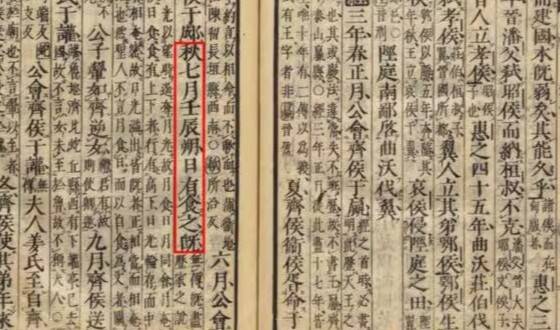
The ancient Chinese text that was studied by the researchers describes a solar eclipse that occurred on April 21, 709 BCE, during the Spring and Autumn period of Chinese history. The text, which is part of the “Spring and Autumn Annals,” provides a detailed description of the eclipse, including the time of day, the direction of the sun, and the extent of the eclipse. By analyzing this text, the researchers were able to calculate how the sun would have appeared from the city of Qufu, which is believed to be the location where the eclipse was observed.
Using advanced astronomical software, the researchers simulated the solar eclipse and calculated the path of totality, which is the region where the eclipse was visible in its entirety. However, when they compared their calculations with the ancient Chinese text, they found a discrepancy. According to the text, the eclipse was total, meaning that the moon completely covered the sun, but the researchers’ calculations suggested that the eclipse was not total from Qufu city. This meant that the city was not located within the path of totality, and therefore, the eclipse would not have been visible in its entirety from that location.
To resolve this discrepancy, the researchers re-examined their calculations and found that the Earth’s rotation speed at the time of the eclipse was slightly faster than it is today. This meant that the city of Qufu was located about eight kilometers off from the path of totality, which explained why the eclipse was not visible in its entirety from that location. This finding has significant implications for our understanding of Earth’s rotation speed over time.
The researchers’ discovery suggests that the Earth’s rotation speed has slowed down over the past 2,700 years. This slowing down of the Earth’s rotation is caused by the tidal interactions between the Earth and the moon, which cause the Earth’s rotation to slow down over time. This process, known as tidal acceleration, is responsible for the lengthening of the Earth’s day by about 1.78 milliseconds per century.
The discovery of the ancient Chinese text and its analysis has provided new insights into the history of Earth’s rotation. By studying the solar eclipse described in the text, the researchers were able to calculate the Earth’s rotation speed at the time of the eclipse and compare it with the current rotation speed. This has allowed them to reconstruct the history of the Earth’s rotation over the past 2,700 years and has provided a new understanding of the Earth’s geological and climatic processes.
The study of ancient texts and their analysis can provide valuable insights into the history of our planet and its processes. The discovery of the ancient Chinese text and its analysis is a testament to the importance of interdisciplinary research, which combines astronomy, history, and geology to understand the Earth’s rotation and its implications for our planet’s climate and geological processes.
In conclusion, the study of the ancient Chinese text has provided new insights into the history of Earth’s rotation. The discovery that the Earth’s rotation speed has slowed down over the past 2,700 years has significant implications for our understanding of the Earth’s geological and climatic processes. The analysis of ancient texts and their study can provide valuable insights into the history of our planet and its processes, and this discovery is a testament to the importance of interdisciplinary research.
This study highlights the importance of understanding the Earth’s rotation and its implications for our planet’s climate and geological processes. By studying the Earth’s rotation and its history, scientists can gain a better understanding of the Earth’s internal dynamics and its interactions with the moon and the sun. This knowledge can be used to improve our understanding of the Earth’s climate and geological processes, which is essential for predicting and mitigating the effects of climate change and natural disasters.
The discovery of the ancient Chinese text and its analysis is a significant contribution to the field of astronomy and geology. It demonstrates the importance of interdisciplinary research and the value of studying ancient texts and their analysis. The study of the Earth’s rotation and its history is an ongoing area of research, and this discovery is a significant step forward in our understanding of the Earth’s rotation and its implications for our planet’s climate and geological processes.
About the Author