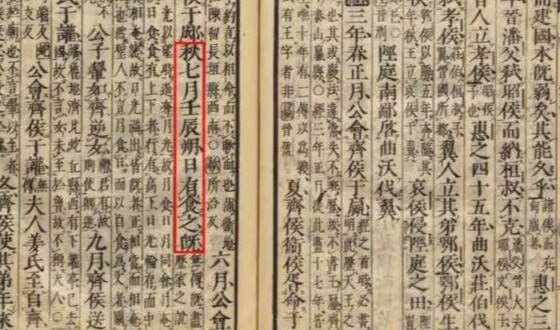
Ancient Chinese text helps to know more about Earth’s rotation
The study of Earth’s rotation has been a fascinating topic for scientists and astronomers for centuries. Understanding the intricacies of our planet’s rotation is crucial for various fields, including astronomy, geology, and climate science. Recently, a team of researchers has made a groundbreaking discovery using an ancient Chinese text that describes a solar eclipse in 709 BCE. This finding has provided new insights into the Earth’s rotation speed, revealing that our planet rotates slower now than it did 2,700 years ago.
The research, published in The Astrophysical Journal Letters, is based on the analysis of an ancient Chinese text that describes a solar eclipse that occurred on April 21, 709 BCE. The text, which is part of the “Spring and Autumn Annals,” a historical record of the state of Lu, describes the eclipse as a total solar eclipse visible from the city of Qufu. However, when the researchers calculated how the Sun would have appeared from Qufu city during the eclipse, they found that the total eclipse would not have been visible from that location.
Using advanced astronomical software, the researchers simulated the solar eclipse and found that the path of totality, where the eclipse would have been visible in its entirety, would have been about eight kilometers away from Qufu city. This discrepancy suggests that the Earth’s rotation has slowed down over the past 2,700 years, causing the planet’s rotation to shift.
The researchers used a combination of historical records, astronomical software, and mathematical models to reconstruct the solar eclipse and determine the Earth’s rotation speed at that time. They found that the Earth’s rotation period, which is the time it takes the planet to complete one rotation on its axis, was shorter in the past. This means that the length of a day on Earth was shorter 2,700 years ago than it is today.
The discovery has significant implications for our understanding of the Earth’s rotation and its impact on the planet’s climate and geology. The slowing down of the Earth’s rotation is caused by the tidal interactions between the Earth and the Moon. As the Moon orbits the Earth, it causes the planet’s rotation to slow down, resulting in longer days. This process, known as tidal acceleration, has been occurring for billions of years and is responsible for the increase in the length of a day on Earth.
The research also highlights the importance of ancient texts and historical records in understanding the Earth’s history. The “Spring and Autumn Annals” is one of the oldest and most reliable historical records of ancient China, and its description of the solar eclipse has provided valuable insights into the Earth’s rotation. The use of ancient texts in scientific research is a growing field, and this study demonstrates the potential of historical records to shed new light on the Earth’s history.
The discovery of the Earth’s slowing rotation has also sparked interest in the potential consequences of this phenomenon. As the Earth’s rotation slows down, the length of a day on our planet increases, which can have significant effects on the planet’s climate and geology. For example, a longer day can result in more extreme weather patterns, such as longer periods of heat or cold, and can also affect the distribution of heat around the globe.
In conclusion, the study of an ancient Chinese text has provided new insights into the Earth’s rotation speed, revealing that our planet rotates slower now than it did 2,700 years ago. The research demonstrates the importance of interdisciplinary approaches to scientific inquiry, combining historical records, astronomical software, and mathematical models to reconstruct the past. The discovery has significant implications for our understanding of the Earth’s rotation and its impact on the planet’s climate and geology, and highlights the potential of ancient texts to shed new light on the Earth’s history.
About the Author