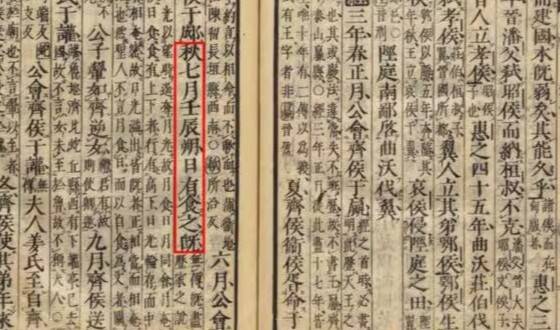
Ancient Chinese text helps to know more about Earth’s rotation
The study of Earth’s rotation has been a fascinating topic for scientists and astronomers for centuries. Understanding the planet’s rotational speed and its variations over time can provide valuable insights into the Earth’s internal structure, the behavior of the oceans and atmosphere, and the planet’s interactions with the Moon and Sun. Recently, a team of researchers has made a groundbreaking discovery using an ancient Chinese text to study the Earth’s rotation speed. The findings, published in The Astrophysical Journal Letters, have shed new light on the planet’s rotational history, revealing that the Earth rotates slower now than it did 2,700 years ago.
The research team focused on an ancient Chinese text that described a solar eclipse that occurred in 709 BCE. The text, which was written during the Spring and Autumn period of Chinese history, provided a detailed account of the eclipse, including the location from which it was observed. The researchers used this information to calculate how the Sun would have appeared from the city of Qufu, which is believed to be the location from which the eclipse was observed. By simulating the eclipse using modern astronomical software, the team found that the total eclipse would not have been visible from Qufu, indicating that the city was located about eight kilometers off from the path of totality.
This discovery has significant implications for our understanding of the Earth’s rotation speed. The fact that Qufu was not in the path of totality during the eclipse suggests that the Earth’s rotation has slowed down over time. This is because the Earth’s rotation causes the planet’s surface to move slightly during the time it takes for the Moon’s shadow to pass over a given location. As a result, the path of totality for a solar eclipse will shift slightly over time due to the Earth’s rotation. By examining the ancient Chinese text and simulating the eclipse, the researchers were able to determine that the Earth’s rotation has slowed down by about 1.8 milliseconds per century.
The study of ancient astronomical events like solar eclipses can provide valuable insights into the Earth’s rotational history. By analyzing the descriptions of these events in ancient texts, scientists can reconstruct the Earth’s rotational speed at different points in the past. This information can be used to better understand the Earth’s internal structure and the interactions between the planet’s oceans, atmosphere, and solid core. The discovery that the Earth rotates slower now than it did 2,700 years ago has significant implications for our understanding of the planet’s geological history and the processes that shape our planet.
The use of ancient Chinese texts to study the Earth’s rotation speed is a testament to the importance of interdisciplinary research. By combining astronomy, history, and geology, scientists can gain a deeper understanding of the Earth’s behavior and the processes that shape our planet. The discovery also highlights the significance of preserving ancient texts and cultural artifacts, which can provide valuable insights into the past and help us better understand the present.
The study of the Earth’s rotation speed is an ongoing area of research, with scientists using a variety of techniques to measure the planet’s rotational speed. These techniques include satellite laser ranging, which involves bouncing lasers off satellites in orbit around the Earth to measure the planet’s rotation, and very long baseline interferometry, which uses a network of radio telescopes to measure the Earth’s rotation. The use of ancient Chinese texts to study the Earth’s rotation speed provides a unique perspective on this topic, allowing scientists to examine the planet’s rotational history over thousands of years.
In conclusion, the discovery that the Earth rotates slower now than it did 2,700 years ago is a significant finding that has important implications for our understanding of the planet’s rotational history. The use of ancient Chinese texts to study the Earth’s rotation speed is a testament to the importance of interdisciplinary research and the value of preserving cultural artifacts. As scientists continue to study the Earth’s rotation speed, they may uncover new insights into the planet’s internal structure, the behavior of the oceans and atmosphere, and the interactions between the Earth and the Moon and Sun.
About the Author