Ancient Chinese text helps to know more about Earth’s rotation
The Earth’s rotation is a fascinating phenomenon that has captivated human imagination for centuries. From ancient civilizations to modern scientists, understanding the intricacies of our planet’s rotation has been a subject of great interest. Recently, a team of researchers has made a groundbreaking discovery that sheds new light on the Earth’s rotation speed, thanks to an ancient Chinese text that describes a solar eclipse in 709 BCE. In a paper published in The Astrophysical Journal Letters, the researchers reveal that the Earth’s rotation has slowed down over the past 2,700 years, providing new insights into the planet’s history.
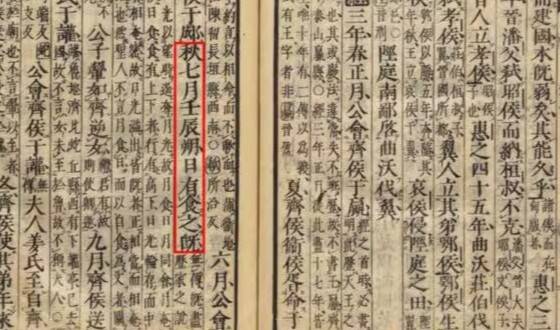
The ancient Chinese text in question is a historical record of a solar eclipse that occurred on April 21, 709 BCE. The text describes the eclipse as a total solar eclipse, which would have been a significant event for the ancient Chinese astronomers. The researchers, however, were intrigued by the fact that the text did not provide a precise location for the eclipse. To solve this mystery, the team decided to use computer simulations to recreate the eclipse and determine its visibility from different locations.
Using advanced astronomical software, the researchers calculated how the Sun would have appeared from the city of Qufu, which was an important cultural and astronomical center in ancient China. To their surprise, they found that the total eclipse would not have been visible from Qufu, despite the text’s description of it as a total eclipse. This discrepancy led the researchers to conclude that Qufu must have been located about eight kilometers off from the path of totality, which is the region where the eclipse is visible in its entirety.
But how does this relate to the Earth’s rotation speed? The answer lies in the fact that the Earth’s rotation is not constant and has been slowing down over time due to the tidal interactions with the Moon. This means that the length of a day on Earth has been increasing over the centuries. By analyzing the ancient Chinese text and simulating the eclipse, the researchers were able to estimate the Earth’s rotation speed at the time of the eclipse.
Their calculations revealed that the Earth’s rotation speed was faster 2,700 years ago than it is today. This finding has significant implications for our understanding of the Earth’s history and the processes that shape our planet. The slowing down of the Earth’s rotation is a result of the Moon’s gravitational pull, which causes the Earth’s rotation to slow down over time. This, in turn, affects the length of a day on Earth, which has been increasing by about 1.8 milliseconds per century.
The discovery also highlights the importance of ancient texts and historical records in understanding the Earth’s history. By studying these records and combining them with modern scientific techniques, researchers can gain new insights into the Earth’s past and the processes that have shaped our planet over time. The ancient Chinese text, in this case, provided a unique window into the Earth’s rotation speed 2,700 years ago, allowing the researchers to reconstruct the planet’s history with unprecedented precision.
The study also underscores the value of interdisciplinary research, which combines different fields of study to achieve a deeper understanding of complex phenomena. In this case, the researchers combined astronomy, history, and geophysics to shed new light on the Earth’s rotation speed. This approach has far-reaching implications for our understanding of the Earth’s history and the processes that shape our planet.
In conclusion, the discovery of the Earth’s rotation speed 2,700 years ago, thanks to an ancient Chinese text, is a remarkable achievement that highlights the importance of interdisciplinary research and the value of ancient texts in understanding the Earth’s history. The finding that the Earth’s rotation has slowed down over the past 2,700 years provides new insights into the planet’s history and the processes that shape our world. As scientists continue to study the Earth’s rotation and its effects on our planet, we can expect to gain a deeper understanding of the complex phenomena that govern our world.
About the Author