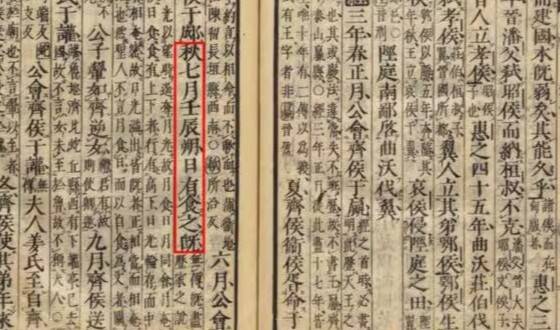
Ancient Chinese text helps to know more about Earth’s rotation
The study of Earth’s rotation has been a topic of interest for scientists and researchers for centuries. Understanding the speed and patterns of our planet’s rotation is crucial for various fields, including astronomy, geology, and climate science. Recently, a team of researchers has made a groundbreaking discovery using an ancient Chinese text that describes a solar eclipse in 709 BCE. This finding has provided new insights into the Earth’s rotation speed, revealing that our planet rotates slower now than it did 2,700 years ago.
The research, published in The Astrophysical Journal Letters, is based on a meticulous analysis of ancient Chinese texts that describe a solar eclipse observed in the city of Qufu, which is located in the Shandong province of China. The texts, written by Chinese astronomers, provide a detailed account of the eclipse, including the time and date of the event. By studying these texts, the researchers were able to calculate how the Sun would have appeared from Qufu city during the eclipse.
Using advanced computer simulations, the researchers recreated the solar eclipse as it would have been seen from Qufu city in 709 BCE. To their surprise, they found that the total eclipse would not have been visible from Qufu, contrary to what was previously believed. This meant that the city of Qufu was not in the path of totality, where the eclipse would have been visible in its entirety.
However, the researchers discovered that Qufu city was only about eight kilometers off from the path of totality. This small discrepancy may seem insignificant, but it has significant implications for our understanding of the Earth’s rotation. By analyzing the data, the researchers concluded that the Earth’s rotation has slowed down over the past 2,700 years.
This finding is supported by various scientific theories, including the tidal acceleration theory, which suggests that the Moon’s gravitational pull on the Earth causes our planet’s rotation to slow down over time. The researchers’ discovery provides strong evidence for this theory, demonstrating that the Earth’s rotation has indeed slowed down over the past few millennia.
The use of ancient Chinese texts to study the Earth’s rotation is a testament to the ingenuity and curiosity of ancient astronomers. The Chinese have a long history of astronomical observations, dating back to the Shang Dynasty (16th-11th centuries BCE). Their meticulous records of celestial events, including solar eclipses, have proven to be invaluable resources for modern scientists.
The discovery also highlights the importance of interdisciplinary research, combining astronomy, history, and computer science to gain new insights into the Earth’s rotation. By analyzing ancient texts and using advanced computer simulations, the researchers were able to reconstruct the solar eclipse and gain a better understanding of the Earth’s rotation.
The implications of this discovery are far-reaching, with potential applications in various fields, including astronomy, geology, and climate science. A better understanding of the Earth’s rotation can help scientists to improve their models of the planet’s climate, oceans, and geology. It can also provide valuable insights into the Earth’s internal dynamics, including the movement of tectonic plates and the behavior of the planet’s core.
In conclusion, the study of ancient Chinese texts has provided new clues about the Earth’s rotation, revealing that our planet rotates slower now than it did 2,700 years ago. This discovery is a testament to the power of interdisciplinary research and the importance of preserving ancient knowledge. As scientists continue to explore the Earth’s rotation and its implications, we can gain a deeper understanding of our planet and its complex systems.
About the Author