Ancient Chinese text helps to know more about Earth’s rotation
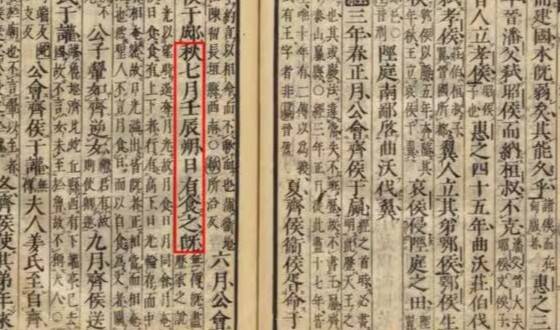
The study of Earth’s rotation has been a fascinating field of research for scientists, with new discoveries constantly shedding light on the intricacies of our planet’s behavior. Recently, a team of researchers made a groundbreaking finding by analyzing ancient Chinese texts that described a solar eclipse in 709 BCE. The study, published in The Astrophysical Journal Letters, provides new data on Earth’s rotation speed, revealing that our planet rotates slower now than it did 2,700 years ago.
To arrive at this conclusion, the researchers delved into ancient Chinese texts that described a solar eclipse that occurred on April 21, 709 BCE. The texts, which were remarkably detailed, allowed the researchers to calculate how the Sun would have appeared from the city of Qufu, which is located in the Shandong province of China. By using advanced astronomical software, the team was able to recreate the eclipse and determine its path across the ancient Chinese landscape.
The researchers found that, according to their calculations, the total eclipse would not have been visible from Qufu city, which was an unexpected result. This discrepancy led them to re-examine their data and consider the possibility that the Earth’s rotation may have changed over time. By carefully analyzing the ancient texts and astronomical data, the team concluded that Qufu city was approximately eight kilometers off from the path of totality, which is the area where the eclipse is fully visible.
This finding has significant implications for our understanding of Earth’s rotation. The fact that Qufu city was not in the path of totality, despite being described as such in the ancient texts, suggests that the Earth’s rotation has slowed down over the past 2,700 years. This slowing down of the Earth’s rotation is a well-known phenomenon, caused by the gravitational interactions between the Earth and the Moon. However, the new study provides a more precise measurement of this effect, allowing scientists to better understand the long-term changes in Earth’s rotation.
The use of ancient Chinese texts to study Earth’s rotation is a testament to the ingenuity and curiosity of ancient civilizations. The fact that these texts have survived for centuries, providing valuable insights into the past, is a remarkable achievement. By combining ancient knowledge with modern astronomical software, the researchers were able to gain a new perspective on the Earth’s behavior, highlighting the importance of interdisciplinary approaches to scientific inquiry.
The study also underscores the significance of preserving historical records and texts, which can provide valuable information about the past and help scientists better understand the present. In this case, the ancient Chinese texts not only offered a glimpse into the astronomical knowledge of ancient civilizations but also contributed to our understanding of Earth’s rotation, a fundamental aspect of our planet’s behavior.
In conclusion, the recent study published in The Astrophysical Journal Letters demonstrates the power of combining ancient knowledge with modern technology to gain new insights into the Earth’s behavior. By analyzing ancient Chinese texts and using advanced astronomical software, the researchers were able to conclude that the Earth rotates slower now than it did 2,700 years ago. This finding has significant implications for our understanding of Earth’s rotation and highlights the importance of preserving historical records and texts.
As scientists continue to study the Earth’s behavior, it is likely that new discoveries will be made, shedding further light on the intricacies of our planet. The use of ancient texts and modern technology will undoubtedly play a significant role in these discoveries, allowing researchers to gain a deeper understanding of the Earth’s behavior and its place in the universe.
The study of Earth’s rotation is an ongoing field of research, with scientists constantly seeking new ways to understand and measure the Earth’s behavior. The recent finding, which used ancient Chinese texts to study Earth’s rotation, is a significant contribution to this field, providing new data and insights into the Earth’s behavior. As we continue to explore and understand our planet, it is essential to recognize the importance of preserving historical records and texts, which can provide valuable information about the past and help scientists better understand the present.
About the Author