Ancient Chinese text helps to know more about Earth’s rotation
The study of Earth’s rotation has been a longstanding pursuit in the field of astronomy. For centuries, scientists have sought to understand the intricacies of our planet’s movement, from the length of a day to the stability of its axis. Recently, a team of researchers has made a groundbreaking discovery by analyzing an ancient Chinese text that describes a solar eclipse in 709 BCE. The findings, published in The Astrophysical Journal Letters, provide new insights into the Earth’s rotation speed, revealing that our planet rotates slower now than it did 2,700 years ago.
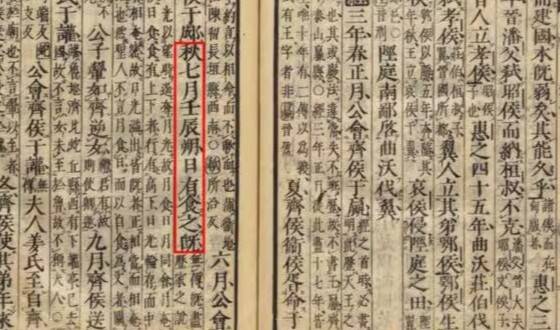
The ancient Chinese text, which has been studied by researchers, describes a solar eclipse that occurred on April 21, 709 BCE. The text, known as the “Records of the Grand Historian,” is a collection of historical documents that chronicle the events of ancient China. The eclipse is described as a total solar eclipse, which would have been a significant event for the ancient Chinese astronomers. However, when researchers calculated how the Sun would have appeared from the city of Qufu, where the eclipse was observed, they found that the total eclipse would not have been visible from that location.
Using advanced computer simulations, the researchers recreated the celestial alignment of the Sun, Moon, and Earth on the day of the eclipse. They found that the path of totality, the region where the eclipse would have been visible in its entirety, would have passed about eight kilometers north of Qufu. This discrepancy suggests that the Earth’s rotation has slowed down over the past 2,700 years, causing the planet’s axis to shift slightly.
The discovery has significant implications for our understanding of the Earth’s rotation. The planet’s rotation is not constant and can be affected by various factors, such as the movement of the Earth’s core and the gravitational pull of the Moon. The slowing down of the Earth’s rotation is a well-known phenomenon, but the new study provides a more precise measurement of this effect. According to the researchers, the Earth’s rotation has slowed down by about 1.8 milliseconds per century, which may seem like a small change, but it adds up over thousands of years.
The study also highlights the importance of ancient astronomical records in understanding the history of our planet. The ancient Chinese text, which was written over 2,700 years ago, provides a unique window into the astronomical events of the past. By analyzing these records, researchers can gain insights into the Earth’s rotation, the movement of the planets, and the behavior of the Sun and Moon. The study demonstrates the value of interdisciplinary research, combining astronomy, history, and computer science to uncover new knowledge about our planet.
The findings of the study also have implications for the field of archaeoastronomy, which is the study of the relationship between astronomy and ancient cultures. The discovery shows that ancient astronomical records can be used to reconstruct the past and understand the cultural and scientific practices of ancient civilizations. The study of ancient Chinese astronomy, in particular, has the potential to reveal new insights into the development of astronomy in ancient China and the exchange of astronomical knowledge between ancient cultures.
In conclusion, the study of an ancient Chinese text has provided new insights into the Earth’s rotation speed, revealing that our planet rotates slower now than it did 2,700 years ago. The discovery demonstrates the importance of interdisciplinary research and the value of ancient astronomical records in understanding the history of our planet. The findings have significant implications for the fields of astronomy, archaeoastronomy, and history, and highlight the potential for new discoveries in the study of ancient cultures and celestial phenomena.
The study is a testament to the power of human curiosity and the importance of exploring the unknown. By analyzing ancient texts and using advanced computer simulations, researchers have been able to uncover new knowledge about our planet and its place in the universe. As we continue to explore the mysteries of the Earth’s rotation and the history of our planet, we may uncover even more surprising discoveries that challenge our understanding of the world and the universe.
About the Author