Aditya-L1 set to observe Sun’s maximum in 2026
The Sun, the star at the center of our solar system, is a dynamic and complex celestial body that has fascinated humans for centuries. Its activity has a significant impact on our planet, influencing everything from the climate to the communication systems. In 2026, the Sun is expected to reach its solar maximum, a peak phase in its 11-year cycle, and India’s first dedicated solar observatory, Aditya-L1, is all set to closely monitor this event.
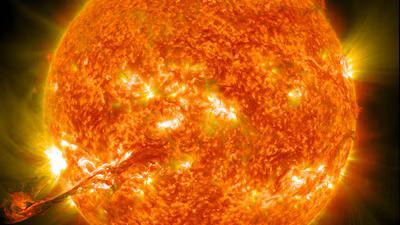
The solar maximum is a period of heightened solar activity, characterized by an increase in sunspots, solar flares, and coronal mass ejections (CMEs). This phase occurs when the Sun’s magnetic poles flip, shifting it from a quiet to an intense activity period. During this time, the Sun’s magnetic field becomes more complex, leading to a significant increase in solar storms and space weather events.
Aditya-L1, which was launched in September 2022, is a state-of-the-art spacecraft designed to study the Sun’s corona, the outer atmosphere of the Sun. The spacecraft is equipped with a range of instruments, including a coronagraph, a solar wind monitor, and a magnetometer, which will allow scientists to study the Sun’s corona and its impact on the solar system in unprecedented detail.
As the Sun approaches its solar maximum in 2026, Aditya-L1 will play a crucial role in monitoring its activity. Scientists expect the Sun to exhibit heightened solar storms, frequent coronal mass ejections, and rapid changes in magnetic activity. These events will provide valuable insights into space weather, which can have a significant impact on our planet.
One of the key areas of focus for Aditya-L1 will be the study of coronal mass ejections (CMEs). CMEs are massive bursts of plasma and magnetic field that are ejected from the Sun’s corona and can travel through the solar system, affecting the magnetic fields of planets and other celestial bodies. By studying CMEs, scientists can gain a better understanding of the Sun’s magnetic field and its impact on the solar system.
Another area of focus for Aditya-L1 will be the study of solar flares. Solar flares are intense bursts of radiation that are emitted by the Sun during periods of high magnetic activity. These events can have a significant impact on the Earth’s magnetic field, causing communication disruptions and power outages. By studying solar flares, scientists can gain a better understanding of the Sun’s magnetic field and its impact on the Earth’s magnetic field.
In addition to studying CMEs and solar flares, Aditya-L1 will also monitor the Sun’s solar wind, which is a stream of charged particles that flows away from the Sun. The solar wind plays a crucial role in shaping the magnetic fields of planets and other celestial bodies, and its study can provide valuable insights into the Sun’s magnetic field and its impact on the solar system.
The data collected by Aditya-L1 during the Sun’s solar maximum will be invaluable for scientists, providing them with a unique opportunity to study the Sun’s corona and its impact on the solar system. The spacecraft’s instruments will provide high-resolution images and spectra of the Sun’s corona, allowing scientists to study the Sun’s magnetic field and its impact on the solar system in unprecedented detail.
The study of the Sun’s solar maximum is not only important for understanding the Sun’s behavior but also for mitigating the impact of space weather events on our planet. By studying the Sun’s magnetic field and its impact on the solar system, scientists can gain a better understanding of the risks associated with space weather events and develop strategies to mitigate their impact.
In conclusion, Aditya-L1 is set to play a crucial role in monitoring the Sun’s solar maximum in 2026. The spacecraft’s instruments will provide valuable insights into the Sun’s corona and its impact on the solar system, allowing scientists to study the Sun’s magnetic field and its impact on the solar system in unprecedented detail. The data collected by Aditya-L1 will be invaluable for scientists, providing them with a unique opportunity to study the Sun’s corona and its impact on the solar system.
As we look forward to the Sun’s solar maximum in 2026, it is exciting to think about the new discoveries that Aditya-L1 will make. The spacecraft’s study of the Sun’s corona and its impact on the solar system will provide valuable insights into the Sun’s behavior and its impact on our planet. With Aditya-L1, India has taken a significant step forward in the field of space research, and we can expect many exciting discoveries in the years to come.
About the Author