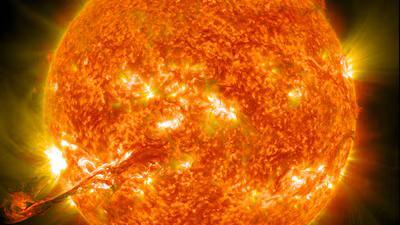
Aditya-L1 set to observe Sun’s maximum in 2026
The year 2026 is expected to be a significant one for space weather enthusiasts and scientists alike, as the Sun is predicted to reach its solar maximum. This peak phase in the Sun’s 11-year cycle is characterized by heightened solar storms, frequent coronal mass ejections, and rapid magnetic activity changes. To closely monitor this phenomenon, India’s first dedicated solar observatory, Aditya-L1, is all set to play a crucial role. In this blog post, we will delve into the significance of the Sun’s solar maximum, the capabilities of Aditya-L1, and what scientists expect to learn from this rare event.
The Sun’s solar cycle, also known as the Schwabe cycle, is an 11-year period of fluctuating magnetic activity. During this cycle, the Sun’s magnetic poles flip, shifting from a quiet phase to an intense phase of activity. The solar maximum, which occurs at the peak of this cycle, is marked by an increase in sunspots, solar flares, and coronal mass ejections (CMEs). These events can have a significant impact on space weather, affecting the Earth’s magnetic field, atmosphere, and even satellite communications.
Aditya-L1, launched by the Indian Space Research Organisation (ISRO) in 2022, is specifically designed to study the Sun’s corona, the outer atmosphere of the Sun. The spacecraft is equipped with a range of instruments, including a coronagraph, a solar wind monitor, and a magnetometer, which will allow scientists to closely monitor the Sun’s magnetic activity, solar wind, and coronal mass ejections. With its advanced instrumentation, Aditya-L1 will provide valuable insights into the Sun’s behavior during the solar maximum, helping scientists to better understand the complex processes that drive space weather.
One of the key objectives of Aditya-L1 is to study the Sun’s corona, which is the region of the Sun’s atmosphere that extends millions of kilometers into space. The corona is much hotter than the Sun’s surface, with temperatures reaching millions of degrees Celsius. This region is also the source of solar winds, which are streams of charged particles that flow away from the Sun and interact with the Earth’s magnetic field. By studying the corona, scientists hope to gain a better understanding of the mechanisms that drive solar winds and CMEs, which can have a significant impact on space weather.
The solar maximum in 2026 is expected to be a particularly intense event, with scientists predicting an increase in solar storms, CMEs, and rapid magnetic activity changes. This will provide a unique opportunity for Aditya-L1 to collect valuable data on the Sun’s behavior during this peak phase. The spacecraft will be able to monitor the Sun’s magnetic field, solar wind, and coronal mass ejections in real-time, providing scientists with a wealth of information on the complex processes that drive space weather.
The data collected by Aditya-L1 during the solar maximum will have significant implications for our understanding of space weather and its impact on the Earth. By studying the Sun’s behavior during this peak phase, scientists will be able to better predict solar storms and CMEs, which can have a significant impact on satellite communications, navigation systems, and even power grids. This knowledge will also help scientists to develop more effective mitigation strategies for protecting our technological systems from the effects of space weather.
In addition to its scientific objectives, Aditya-L1 also marks a significant milestone in India’s space program. The spacecraft is India’s first dedicated solar observatory, and its launch demonstrates the country’s growing capabilities in space exploration. The success of Aditya-L1 will pave the way for future Indian space missions, including the planned launch of a lunar mission and a human spaceflight program.
In conclusion, the solar maximum in 2026 is expected to be a significant event, with the Sun reaching its peak phase of magnetic activity. Aditya-L1, India’s first dedicated solar observatory, is all set to play a crucial role in monitoring this phenomenon. With its advanced instrumentation and capabilities, the spacecraft will provide valuable insights into the Sun’s behavior during the solar maximum, helping scientists to better understand the complex processes that drive space weather. As we look forward to this rare event, we can expect significant advances in our understanding of the Sun and its impact on the Earth.
About the Author