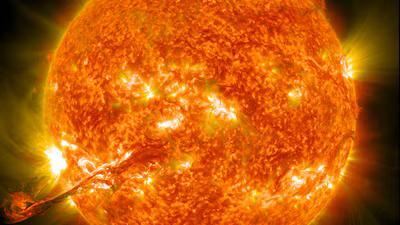
Aditya-L1 set to observe Sun’s maximum in 2026
The Sun, the star at the center of our solar system, is a dynamic and ever-changing entity. Its activity waxes and wanes over an 11-year cycle, with periods of intense magnetic activity and solar storms giving way to quieter periods of relative calm. In 2026, the Sun is expected to reach its solar maximum, a peak phase in its 11-year cycle characterized by heightened solar storms, frequent coronal mass ejections, and rapid changes in magnetic activity. And India’s first dedicated solar observatory, Aditya-L1, will be ready to closely monitor this event, offering scientists valuable insights into space weather.
The Aditya-L1 mission, launched by the Indian Space Research Organisation (ISRO), is designed to study the Sun’s corona, the outer atmosphere of the Sun that is visible during a total solar eclipse. The spacecraft is equipped with a range of instruments, including a coronagraph, a solar wind monitor, and a magnetometer, which will allow scientists to study the Sun’s magnetic field, solar wind, and coronal mass ejections in unprecedented detail.
The solar maximum, which occurs when the Sun’s magnetic poles flip, shifting it from a period of quiet activity to one of intense activity, is a critical phase in the Sun’s 11-year cycle. During this time, the Sun’s magnetic field becomes increasingly complex, leading to a higher frequency of solar flares and coronal mass ejections. These events can have a significant impact on Earth’s magnetic field, causing geomagnetic storms that can disrupt communication systems, power grids, and other technological infrastructure.
The Aditya-L1 mission is well-positioned to take advantage of this unique opportunity to study the Sun’s behavior during its solar maximum. By closely monitoring the Sun’s activity, scientists will be able to gain a deeper understanding of the underlying mechanisms that drive the Sun’s magnetic field and solar wind. This knowledge will be invaluable in helping us better predict and prepare for the potential impacts of space weather on our planet.
One of the key areas of focus for the Aditya-L1 mission will be the study of coronal mass ejections (CMEs). CMEs are massive bursts of plasma and magnetic field that are ejected from the Sun’s corona, often in association with solar flares. These events can have a significant impact on Earth’s magnetic field, causing geomagnetic storms that can disrupt communication systems and power grids. By studying CMEs in detail, scientists will be able to better understand the mechanisms that drive these events and improve their ability to predict when and how they will occur.
Another key area of focus for the Aditya-L1 mission will be the study of the Sun’s magnetic field. The Sun’s magnetic field is a complex and dynamic entity that plays a critical role in shaping the Sun’s behavior. By studying the Sun’s magnetic field in detail, scientists will be able to gain a deeper understanding of the underlying mechanisms that drive the Sun’s activity, including the formation of sunspots, the eruption of solar flares, and the ejection of coronal mass ejections.
The Aditya-L1 mission is also expected to provide valuable insights into the Sun’s impact on Earth’s climate. The Sun’s energy output varies over its 11-year cycle, with the solar maximum corresponding to a peak in the Sun’s energy output. By studying the Sun’s energy output and its impact on Earth’s climate, scientists will be able to better understand the role that the Sun plays in shaping our planet’s climate and weather patterns.
In addition to its scientific objectives, the Aditya-L1 mission is also expected to have a significant impact on India’s space program. The mission marks a major milestone in India’s efforts to develop its own space-based solar observatory, and demonstrates the country’s growing capabilities in space exploration. The mission is also expected to provide opportunities for international collaboration, with scientists from around the world working together to analyze the data returned by the Aditya-L1 spacecraft.
In conclusion, the Aditya-L1 mission is set to play a critical role in our understanding of the Sun’s behavior during its solar maximum in 2026. By closely monitoring the Sun’s activity, scientists will be able to gain a deeper understanding of the underlying mechanisms that drive the Sun’s magnetic field and solar wind, and improve their ability to predict and prepare for the potential impacts of space weather on our planet. The mission is a major milestone in India’s space program, and demonstrates the country’s growing capabilities in space exploration.
About the Author