Aditya-L1 set to observe Sun’s maximum in 2026
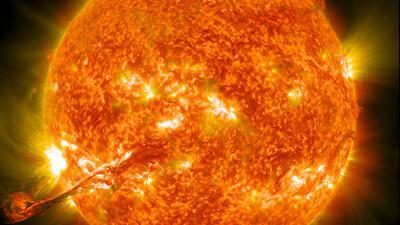
The Sun, the star at the center of our solar system, is a dynamic and ever-changing entity. Its activity has a significant impact on the Earth’s magnetic field, atmosphere, and climate. The Sun’s activity follows an 11-year cycle, with periods of high and low activity. The next peak in this cycle, known as the solar maximum, is expected to occur in 2026. India’s first dedicated solar observatory, Aditya-L1, is all set to closely monitor the Sun during this period, providing valuable insights into space weather.
The Aditya-L1 mission, launched by the Indian Space Research Organisation (ISRO), is designed to study the Sun’s corona, the outer atmosphere of the Sun. The spacecraft is equipped with a suite of instruments that will help scientists understand the Sun’s magnetic field, plasma, and radiation. The observatory will be positioned at the L1 (Lagrange point 1), a gravitationally stable location about 1.5 million kilometers from the Earth, where it will have an uninterrupted view of the Sun.
The solar maximum, expected to occur in 2026, is a critical phase in the Sun’s 11-year cycle. During this period, the Sun’s magnetic poles flip, shifting it from a quiet to an intense activity phase. This phase is characterized by heightened solar storms, frequent coronal mass ejections, and rapid magnetic activity changes. These events can have a significant impact on the Earth’s magnetic field, causing geomagnetic storms that can disrupt communication and navigation systems.
The Aditya-L1 observatory will play a crucial role in monitoring the Sun’s activity during this period. The spacecraft will provide high-resolution images and spectra of the Sun’s corona, helping scientists to understand the underlying mechanisms that drive the Sun’s activity. The observatory will also study the Sun’s magnetic field, plasma, and radiation, providing valuable insights into the physical processes that occur during the solar maximum.
One of the key objectives of the Aditya-L1 mission is to study the Sun’s coronal heating problem. The corona, the outer atmosphere of the Sun, is millions of degrees hotter than the Sun’s surface. Scientists are still unsure about the mechanisms that heat the corona to such high temperatures. The Aditya-L1 observatory will provide high-resolution images and spectra of the corona, helping scientists to understand the physical processes that occur in this region.
The Aditya-L1 mission will also study the Sun’s solar wind, a stream of charged particles that emanates from the Sun’s corona. The solar wind plays a crucial role in shaping the Earth’s magnetic field and atmosphere. The observatory will provide detailed measurements of the solar wind’s speed, density, and temperature, helping scientists to understand its impact on the Earth’s space weather.
The data collected by the Aditya-L1 observatory will be used to improve our understanding of space weather. Space weather refers to the dynamic and variable conditions in the space environment that can affect the Earth’s magnetic field, atmosphere, and climate. The data will help scientists to develop more accurate models of the Sun’s activity and its impact on the Earth, enabling better forecasting of space weather events.
In addition to its scientific objectives, the Aditya-L1 mission will also provide opportunities for international collaboration. The mission will be supported by a team of scientists from around the world, who will work together to analyze the data collected by the observatory. The mission will also provide opportunities for students and young researchers to participate in the analysis of the data, helping to develop the next generation of solar physicists.
In conclusion, the Aditya-L1 observatory is set to play a crucial role in monitoring the Sun’s activity during the solar maximum in 2026. The spacecraft will provide high-resolution images and spectra of the Sun’s corona, helping scientists to understand the underlying mechanisms that drive the Sun’s activity. The mission will provide valuable insights into space weather, enabling better forecasting of space weather events. With its advanced suite of instruments and its unique location at the L1 point, the Aditya-L1 observatory is poised to make significant contributions to our understanding of the Sun and its impact on the Earth.
About the Author