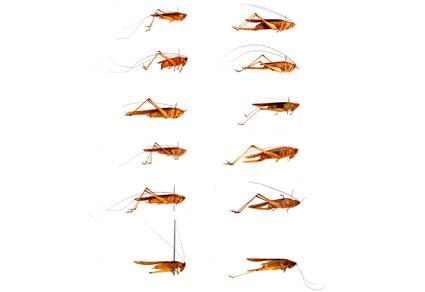
3 new species of ‘musical’ katydids discovered in Kashmir
The Kashmir region, known for its breathtaking natural beauty, has long been a subject of interest for researchers and scientists. The region’s unique geography and climate support a diverse range of flora and fauna, many of which remain unexplored. In a recent discovery, a team of researchers surveying meadows in Kashmir stumbled upon three new species of “musical” meadow katydids, previously unrecorded in the region. These fascinating insects, belonging to the genus Conocephalus, have been named C usmanii, C nagariensis, and C ganderbali after detailed studies.
The discovery of these new species is significant, as it highlights the rich biodiversity of the Kashmir region and the importance of continued exploration and research. The team, comprised of experts in entomology and ecology, conducted extensive surveys of the meadows in Kashmir, using a combination of field observations and laboratory analysis to identify and classify the new species.
The genus Conocephalus, commonly known as meadow katydids, is a group of insects characterized by their distinctive musical calls. These calls, often described as a series of chirps or whistles, are used by the katydids to communicate with each other and attract mates. The three new species discovered in Kashmir, C usmanii, C nagariensis, and C ganderbali, each have unique call patterns and characteristics that distinguish them from other known species.
C usmanii, named after the renowned Pakistani entomologist, Dr. Muhammad Usman, is characterized by its distinctive call pattern, which consists of a series of high-pitched chirps. This species was found to be widely distributed across the meadows of Kashmir, with a strong presence in the regions of Srinagar and Anantnag.
C nagariensis, on the other hand, is named after the Nagari village in the Kupwara district of Kashmir. This species has a unique call pattern, consisting of a series of low-pitched whistles, and was found to be restricted to the higher elevations of the meadows.
The third new species, C ganderbali, is named after the Ganderbal district of Kashmir. This species has a distinctive call pattern, consisting of a series of high-pitched whistles, and was found to be widely distributed across the meadows of the region.
In addition to the three new species, the research team also recorded several known katydid species in the region that were not previously documented there. One such species, C longipennis, was found to be present in the meadows of Kashmir, although its distribution and abundance were not well understood.
The discovery of these new species highlights the importance of continued exploration and research in the Kashmir region. The region’s unique geography and climate support a diverse range of flora and fauna, many of which remain unexplored. Further research is needed to fully understand the ecology and conservation status of these new species, as well as the other katydid species found in the region.
The discovery of the three new species of “musical” meadow katydids in Kashmir is a significant addition to our understanding of the region’s biodiversity. The research team’s findings have been published in a recent issue of the journal Zootaxa, and provide a valuable contribution to the field of entomology.
As we continue to explore and learn more about the natural world, discoveries like these serve as a reminder of the importance of conservation and the need to protect our planet’s precious biodiversity. The Kashmir region, with its unique geography and climate, is a treasure trove of unexplored species, and further research is needed to fully understand and appreciate its natural beauty.
In conclusion, the discovery of the three new species of “musical” meadow katydids in Kashmir is a significant finding that highlights the region’s rich biodiversity. The research team’s findings provide a valuable contribution to the field of entomology, and serve as a reminder of the importance of continued exploration and research. As we move forward, it is essential that we prioritize conservation efforts and work to protect the natural beauty of the Kashmir region for future generations.
Source: https://mapress.com/zt/article/view/zootaxa.5737.4.4
About the Author