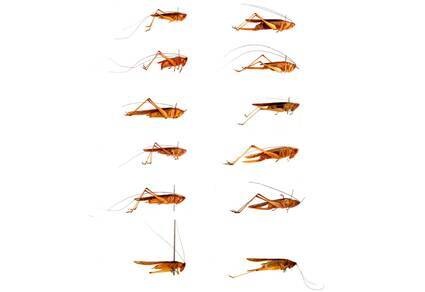
3 new species of ‘musical’ katydids discovered in Kashmir
The meadows of Kashmir, a region nestled in the Himalayan Mountains, are known for their breathtaking beauty and diverse wildlife. Recently, a team of researchers surveying these meadows made a groundbreaking discovery, uncovering three new species of “musical” meadow katydids, insects in the genus Conocephalus, that were previously unrecorded in the region. The findings, which were published in a recent study, have shed new light on the insect fauna of Kashmir and highlight the importance of continued exploration and documentation of the region’s biodiversity.
The three new species, named C usmanii, C nagariensis, and C ganderbali, were identified after detailed studies of their morphology, behavior, and song patterns. The team of researchers, comprising experts in entomology and ecology, conducted extensive field surveys in the meadows of Kashmir, collecting and analyzing specimens of katydids. The study not only revealed the presence of these new species but also provided valuable insights into their habitats, diets, and behaviors.
The genus Conocephalus, to which these new species belong, is known for its “musical” characteristics. Male katydids in this genus are capable of producing complex songs, often used for mating and territorial purposes. The songs, which can be heard during the summer months, are a series of chirps and trills that are unique to each species. The researchers recorded and analyzed the song patterns of the new species, which helped in distinguishing them from other known species of katydids.
The discovery of these new species is significant, as it highlights the rich biodiversity of the Kashmir region. The meadows of Kashmir, with their unique combination of flora and fauna, provide a habitat for a wide range of insects, including katydids. The study suggests that the region’s insect fauna is still poorly understood and that further research is needed to fully document the diversity of insects in the area.
In addition to the three new species, the research team also recorded several other known katydid species in the region that were not previously documented there. One such species, C longipennis, was found to be present in the meadows of Kashmir, although its presence was not previously known. The study provides a comprehensive list of katydid species found in the region, including their distribution, habitats, and abundance.
The discovery of these new species of katydids has important implications for conservation efforts in the region. The meadows of Kashmir are facing threats from human activities such as overgrazing, deforestation, and urbanization, which can lead to habitat loss and fragmentation. The study highlights the need for conservation efforts to protect the region’s biodiversity, including its insect fauna. By documenting the diversity of insects in the area, researchers can identify areas of high conservation value and develop strategies to protect these areas.
The study also underscores the importance of continued exploration and documentation of the region’s biodiversity. The discovery of these new species of katydids is a testament to the fact that there is still much to be learned about the natural world. By supporting research and conservation efforts, we can work towards a better understanding of the world around us and take steps to protect it for future generations.
In conclusion, the discovery of three new species of “musical” meadow katydids in Kashmir is a significant finding that highlights the rich biodiversity of the region. The study provides a valuable contribution to our understanding of the insect fauna of Kashmir and underscores the need for continued research and conservation efforts to protect the region’s unique and fragile ecosystem.
For more information on this study, please visit: https://mapress.com/zt/article/view/zootaxa.5737.4.4
News Source: https://mapress.com/zt/article/view/zootaxa.5737.4.4
About the Author