Would Disown My Son If He Had Pakistan Links: Assam CM
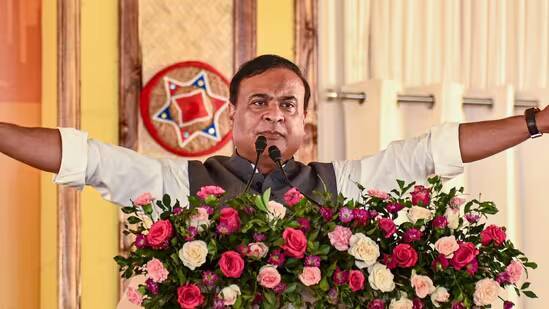
In a shocking statement, Assam Chief Minister Himanta Biswa Sarma has sparked controversy by declaring that he would disown his own son if he had any ties with Pakistan. This statement, which has sent shockwaves across the nation, was made in an apparent reference to Congress MP Gaurav Gogoi’s wife, Elizabeth, who allegedly has links with Pakistan. The Chief Minister’s bold claim has raised several questions about the implications of having connections with a neighboring country that has been at odds with India for decades.
Sarma’s statement was made during a public gathering, where he posed a rhetorical question to the audience, asking whether a Congress leader whose wife has links with Pakistan would have the courage to disown her. He further emphasized his point by saying, “If one becomes Pakistani…how can I have relation with them?” This statement has been perceived as a direct attack on the Congress party and its leaders, particularly Gaurav Gogoi, whose wife’s alleged links with Pakistan have been a subject of debate.
The Assam CM’s statement has sparked a heated debate across the country, with many questioning the rationale behind his claim. While some have praised Sarma for his nationalist stance, others have criticized him for making such a drastic statement. The implications of disowning a family member for having ties with Pakistan are far-reaching and complex. It raises questions about the nature of relationships, loyalty, and patriotism.
In India, the relationship between the country and Pakistan has always been tense, with both nations having a long history of conflict. The two countries have fought several wars, and the Line of Control (LoC) in Kashmir remains a major point of contention. Given this backdrop, it is not surprising that having ties with Pakistan can be perceived as a sensitive issue. However, the question remains whether disowning a family member is an appropriate response to such a situation.
Sarma’s statement has also been seen as a attempt to polarize the public and create a sense of nationalism. By making such a bold claim, he may be trying to project himself as a strong leader who is committed to the nation’s interests. However, this approach can also be counterproductive, as it may create divisions within the society and foster an atmosphere of intolerance.
The Congress party has been quick to respond to Sarma’s statement, with many of its leaders criticizing the Assam CM for his “irresponsible” remarks. The party has argued that Sarma’s statement is an attempt to deflect attention from the real issues facing the country, such as poverty, unemployment, and inequality. The party has also pointed out that having ties with Pakistan does not necessarily mean that one is anti-India or unpatriotic.
In conclusion, the Assam CM’s statement has sparked a heated debate across the country, with many questioning the implications of having ties with Pakistan. While Sarma’s nationalist stance may have resonated with some, it is essential to consider the complexities of relationships, loyalty, and patriotism. Disowning a family member for having ties with Pakistan may not be the most effective or humane response to such a situation. Instead, it is crucial to foster a sense of understanding, tolerance, and inclusivity, where individuals are not judged solely on the basis of their relationships or associations.
About the Author