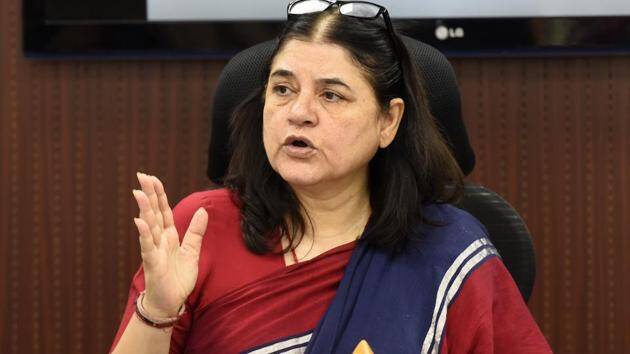
Those bursting crackers should be called ‘anti-national’: Maneka
As the festive season approaches, the debate around firecrackers and their impact on the environment has gained momentum. BJP leader Maneka Gandhi has sparked a controversy by calling for a nationwide ban on firecrackers, citing the severe air pollution in New Delhi as the primary reason. In a statement that has sent shockwaves across the country, Gandhi asserted that those who burst firecrackers should be labeled as “anti-national.”
The statement comes at a time when the national capital is grappling with hazardous air quality, with the Air Quality Index (AQI) often crossing the 500 mark. The situation is so dire that the Supreme Court has had to intervene, imposing restrictions on the sale and use of firecrackers in the city. However, despite these efforts, the air quality continues to deteriorate, with the bursting of firecrackers being a significant contributor to the problem.
Gandhi’s comments have sparked a heated debate, with many questioning the rationale behind her statement. “If you will burst firecrackers worth ₹800 crore in two nights, then what will happen to the air?” she asked, highlighting the enormity of the problem. The figure of ₹800 crore is staggering, and it is estimated that this amount is spent on firecrackers during the festive season, particularly on Diwali and New Year’s Eve.
The environmental impact of firecrackers is well-documented. The bursting of firecrackers releases a cocktail of toxic chemicals, including particulate matter, carbon monoxide, and volatile organic compounds, into the air. These pollutants can cause respiratory problems, cardiovascular disease, and even cancer. The effects are particularly devastating for children, the elderly, and those with pre-existing medical conditions.
Moreover, the air pollution caused by firecrackers is not limited to the festive season. The pollutants released into the air can linger for days, even weeks, after the festivities are over. This means that the air quality continues to suffer long after the celebrations have ended, putting the health of millions at risk.
Gandhi’s call for a nationwide ban on firecrackers is not without precedent. Several countries, including China, Japan, and Singapore, have implemented strict regulations on the use of firecrackers due to environmental and health concerns. In India, the Supreme Court has already imposed restrictions on the sale and use of firecrackers in Delhi, and other states are following suit.
However, the question remains whether labeling those who burst firecrackers as “anti-national” is the right approach. While the intention behind Gandhi’s statement is to highlight the severity of the problem, it is essential to consider the potential consequences of such a label. The term “anti-national” is often associated with treason or sedition, and using it to describe someone who bursts firecrackers may be seen as an overreach.
Instead of resorting to such drastic measures, it may be more effective to educate people about the risks associated with firecrackers and encourage them to adopt alternative, eco-friendly ways of celebrating festivals. This could include organizing community events, using eco-friendly firecrackers, or simply avoiding the use of firecrackers altogether.
In conclusion, Maneka Gandhi’s call for a nationwide ban on firecrackers has sparked a necessary debate about the environmental impact of firecrackers. While labeling those who burst firecrackers as “anti-national” may not be the most effective approach, it is essential to acknowledge the severity of the problem and work towards finding solutions. As the festive season approaches, it is crucial that we prioritize the health and well-being of our citizens and take concrete steps to mitigate the effects of air pollution.
Ultimately, it is up to us to decide whether the fleeting pleasure of bursting firecrackers is worth the long-term consequences for our health and the environment. As we celebrate the festive season, let us do so with sensitivity and responsibility, keeping in mind the impact of our actions on those around us and the planet we call home.
News Source: https://repository.inshorts.com/articles/en/PTI/05dfed30-2874-4e50-8c78-37383df29516
About the Author