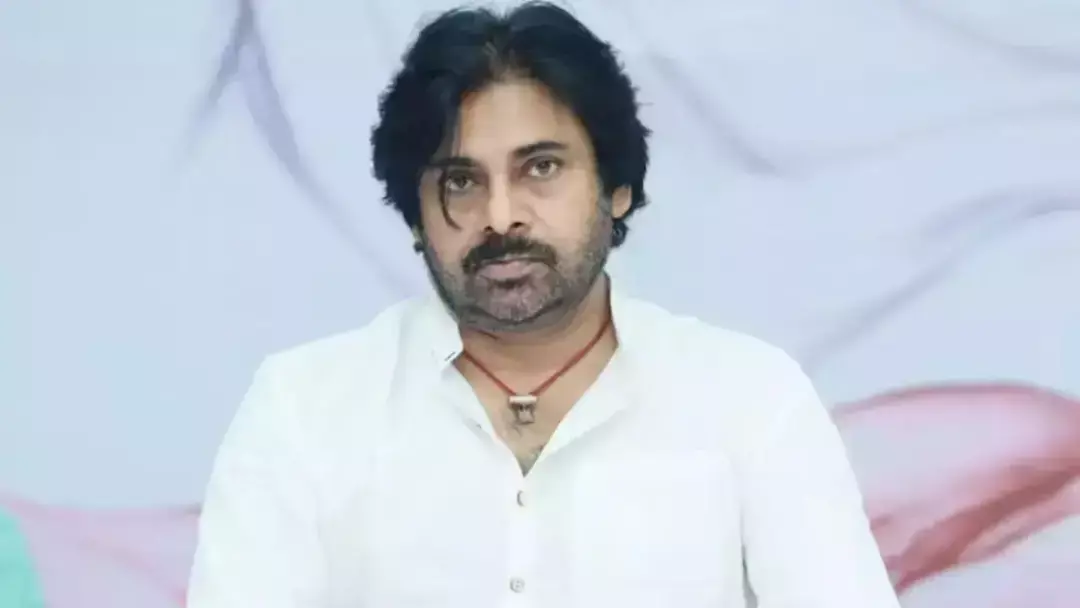
T’gana Minister Slams Pawan for ‘Evil Eye’ Remark, Warns Film Ban
The world of politics and entertainment often collide, and the latest controversy surrounding Telugu actor and Deputy Chief Minister Pawan Kalyan is a prime example. In a shocking turn of events, Pawan Kalyan has landed himself in hot water after making a remark about the dying coconut trees in the Konaseema region, attributing the cause to an “evil eye.” This comment has not gone down well with the Telangana government, particularly with Cinematography Minister Komatireddy Venkat Reddy, who has demanded an apology from the actor-turned-politician.
The controversy began when Pawan Kalyan visited the Konaseema region, where he was apprised of the situation regarding the dying coconut trees. Instead of offering a solution or expressing concern, Kalyan made a statement that has been perceived as insensitive and superstitious. He claimed that the trees were dying due to an “evil eye,” which has sparked widespread criticism and outrage. The comment was seen as a trivialization of the issue, and many have accused Kalyan of lacking empathy and understanding of the problems faced by the farmers in the region.
Minister Komatireddy Venkat Reddy was quick to respond to Kalyan’s comment, slamming him for his “irresponsible” statement. Reddy demanded an apology from Kalyan, stating that his remark was an insult to the farmers who are struggling to save their crops. The minister warned that if Kalyan fails to apologize, his films will not be allowed to release in Telangana. Reddy said, “If Pawan Kalyan apologizes, his movies will be screened at least a couple of days, if he fails to apologize, his films won’t release anywhere in Telangana.” This statement has sent shockwaves in the film industry, as it could have significant implications for Kalyan’s upcoming projects.
The demand for an apology from Pawan Kalyan has sparked a heated debate, with many questioning the minister’s stance. While some have supported Reddy’s demand, others have criticized him for trying to censor Kalyan’s freedom of speech. The issue has also raised questions about the role of politicians in the film industry and the limits of their power. Can a minister really dictate what films can or cannot be released in a state? The answer to this question is complex and depends on various factors, including the laws and regulations governing film censorship.
The controversy surrounding Pawan Kalyan’s comment has also highlighted the issue of superstition and its prevalence in Indian society. While many Indians still believe in superstitions, others see them as a hindrance to progress and rational thinking. The fact that a public figure like Pawan Kalyan has attributed the dying of coconut trees to an “evil eye” has been seen as a setback for the country’s efforts to promote scientific thinking and critical inquiry.
In recent years, there have been several instances of films being banned or facing censorship due to political pressure. The issue of film censorship is a sensitive one, and it requires a delicate balance between artistic freedom and social responsibility. While films have the power to shape public opinion and influence culture, they can also be used to spread hate or promote divisive ideologies. In such cases, censorship may be necessary to protect the interests of the society.
However, in the case of Pawan Kalyan’s films, the issue is not about censorship but about the minister’s attempt to dictate what can or cannot be released in the state. This raises important questions about the limits of political power and the role of ministers in the film industry. Can a minister unilaterally decide to ban a film or dictate its release? The answer to this question is no, as it would be a violation of the fundamental rights of the filmmakers and the audience.
In conclusion, the controversy surrounding Pawan Kalyan’s comment has highlighted the complex issues surrounding film censorship, political power, and superstition. While the demand for an apology from Kalyan is understandable, the threat to ban his films is not justified. The film industry should be allowed to function independently, without political interference or censorship. The government should focus on promoting artistic freedom and encouraging filmmakers to produce content that is socially responsible and culturally sensitive.
As the controversy continues to unfold, it remains to be seen how Pawan Kalyan will respond to the minister’s demand. Will he apologize for his comment, or will he stand his ground? The outcome of this controversy will have significant implications for the film industry and the relationship between politicians and filmmakers.
About the Author