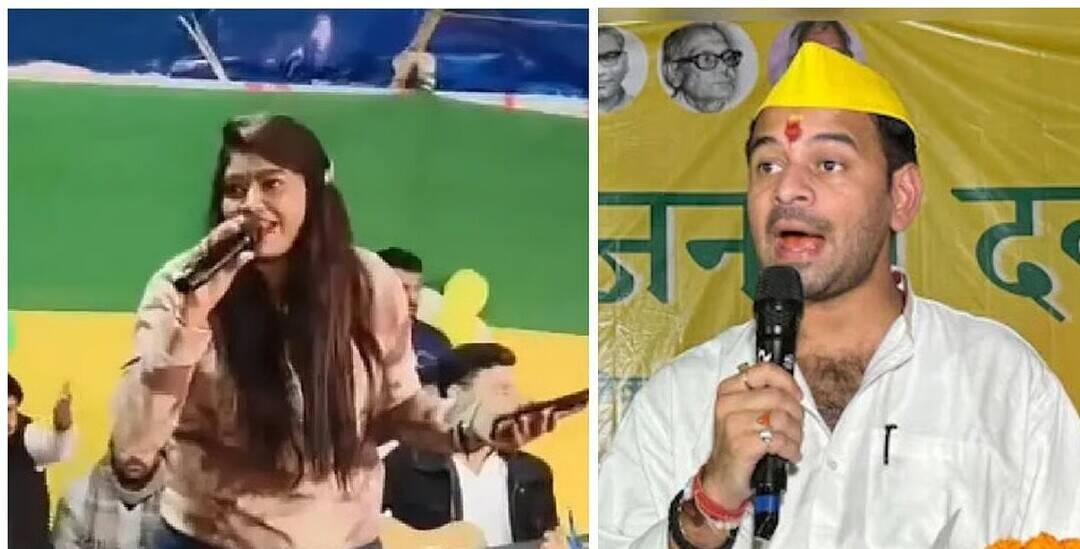
Tej Pratap asks singer to not sing ‘vulgar’ songs at Patna event
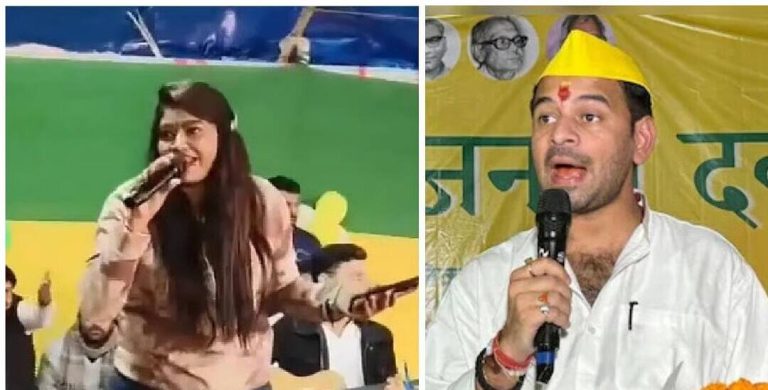
In a recent incident, a video of Janata Dal (United) leader and former Bihar health minister Tej Pratap Yadav has gone viral on social media. The video shows Yadav interrupting a Bhojpuri singer in the middle of her performance at a Makar Sankranti event in Patna. The reason for the interruption was the singer’s choice of songs, which Yadav deemed “vulgar” and not suitable for the occasion.
As seen in the video, Yadav steps onto the stage and politely, yet firmly, requests the singer to stop singing the current song. He is heard saying, “Vulgar gaana mat gaao, bhajan gaao” which translates to “Don’t sing vulgar songs, sing hymns instead.” He further suggests that the singer should sing devotional songs, specifically hymns of Lord Krishna, saying “Krishna ji wala bhajan gaao” (sing hymns of Lord Krishna).
The video has sparked a mix of reactions on social media, with some people praising Yadav for his stance against “vulgar” content, while others have criticized him for interfering with the singer’s performance. The incident has also raised questions about the definition of “vulgar” and who gets to decide what is acceptable or not.
The Makar Sankranti event, where the incident took place, is a significant festival in the Hindu calendar, marking the beginning of the sun’s journey towards the northern hemisphere. It is a time for celebration and worship, and many people attend events and gatherings to mark the occasion. In this context, Yadav’s request for the singer to sing devotional songs can be seen as an attempt to maintain the spirit of the festival and avoid any content that may be deemed objectionable.
However, the incident also highlights the complexities of cultural norms and personal preferences. What one person considers “vulgar” or objectionable, another person may not. The singer, who was interrupted by Yadav, may have had a different understanding of what is acceptable or not, and her choice of songs may have been based on her own artistic expression or the expectations of her audience.
The role of politicians and public figures in shaping cultural norms and influencing artistic expression is also a topic of debate. While some may argue that public figures have a responsibility to promote cultural values and decency, others may see their interference as an attempt to impose their own personal beliefs or biases on others.
In this case, Yadav’s actions have been seen as a reflection of his own values and principles, which emphasize the importance of cultural sensitivity and respect for traditional norms. As a leader of the Janata Dal (United) party, Yadav has been known for his strong stance on social and cultural issues, and his intervention at the Makar Sankranti event is consistent with his public image.
The incident has also sparked a wider conversation about the state of Bhojpuri music and the role of artists in promoting cultural values. Bhojpuri music, which originated in the Bihar region, has a rich cultural heritage and is known for its folk melodies and lyrics that reflect the lives and traditions of the people. However, in recent years, some critics have argued that the genre has become increasingly commercialized and has lost its traditional charm.
In this context, Yadav’s request for the singer to sing devotional songs can be seen as an attempt to reconnect with the traditional roots of Bhojpuri music and promote a more nuanced and culturally sensitive form of artistic expression.
In conclusion, the incident at the Makar Sankranti event in Patna has highlighted the complexities of cultural norms, personal preferences, and the role of public figures in shaping artistic expression. While some may see Yadav’s intervention as an attempt to impose his own values on others, others may view it as a genuine attempt to promote cultural sensitivity and respect for traditional norms.
As the debate continues, it is essential to recognize the importance of artistic freedom and the need for cultural expression to be diverse and inclusive. At the same time, it is also crucial to acknowledge the role of cultural leaders and public figures in promoting values and norms that are respectful and considerate of all members of society.
About the Author