Tej Pratap asks singer to not sing ‘vulgar’ songs at Patna event
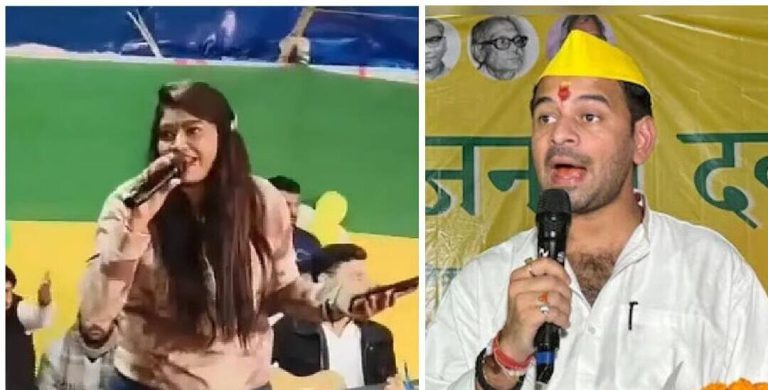
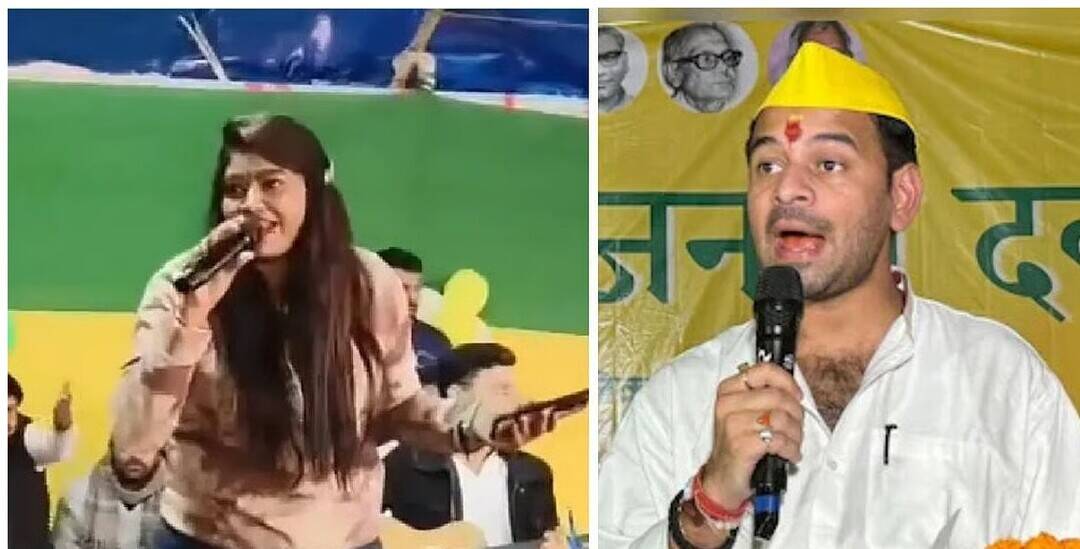
In a surprising turn of events, Janata Dal (United) leader and former Bihar Health Minister, Tej Pratap Yadav, was seen interrupting a Bhojpuri singer in the middle of her performance at a Makar Sankranti event in Patna. The incident, which has been captured on video, shows Yadav asking the singer to refrain from singing “vulgar” songs and instead sing devotional songs. The video has since gone viral on social media, sparking a heated debate about the role of politicians in censoring artistic expression.
According to eyewitnesses, the singer was performing at the event, which was organized to celebrate the occasion of Makar Sankranti, a significant festival in the Hindu calendar. The singer, who was reportedly singing a popular Bhojpuri song, was suddenly interrupted by Yadav, who walked up to the stage and asked her to stop singing. “Vulgar gaana mat gaao, bhajan gaao (don’t sing vulgar songs, sing hymns),” he said, as the crowd watched in surprise.
Yadav, who is known for his outspoken and sometimes controversial views, was heard telling the singer to sing devotional songs instead. “Krishna ji wala bhajan gaao (sing hymns of Lord Krishna),” he added, as the singer nodded and agreed to comply with his request. The incident has sparked a debate about the role of politicians in dictating what kind of music can be performed at public events.
While some have praised Yadav for taking a stand against “vulgar” content, others have criticized him for trying to impose his own moral standards on others. “It’s not up to politicians to decide what kind of music is acceptable or not,” said one social media user. “Artistic freedom is important, and politicians should not try to censor it.”
Others have pointed out that the incident is not an isolated one, and that there have been several instances in the past where politicians have tried to dictate what kind of music can be performed at public events. “This is not the first time that a politician has tried to censor music,” said another social media user. “It’s a worrying trend, and it’s important that we speak out against it.”
The incident has also sparked a debate about the definition of “vulgar” content. While some people may view certain types of music or dance as “vulgar”, others may not. “What one person considers ‘vulgar’ may not be the same for another person,” said a music critic. “It’s subjective, and it’s not up to politicians to decide what is acceptable or not.”
In recent years, there have been several instances of politicians and moral police trying to dictate what kind of music can be performed at public events. In some cases, singers and musicians have been forced to cancel their performances due to threats from extremist groups or politicians. The incident involving Tej Pratap Yadav is just the latest example of this trend.
As the debate rages on, it’s clear that the incident has sparked a wider conversation about the role of politicians in censoring artistic expression. While some people may agree with Yadav’s views on “vulgar” content, others may see it as an attempt to impose his own moral standards on others. As one social media user put it, “It’s time for politicians to focus on more important issues, rather than trying to dictate what kind of music we can listen to.”
In conclusion, the incident involving Tej Pratap Yadav and the Bhojpuri singer has sparked a heated debate about the role of politicians in censoring artistic expression. While some people may view Yadav’s actions as a positive step towards promoting devotional music, others may see it as an attempt to impose his own moral standards on others. As the conversation continues, it’s clear that the issue is more complex than it seems, and that there are no easy answers.
About the Author