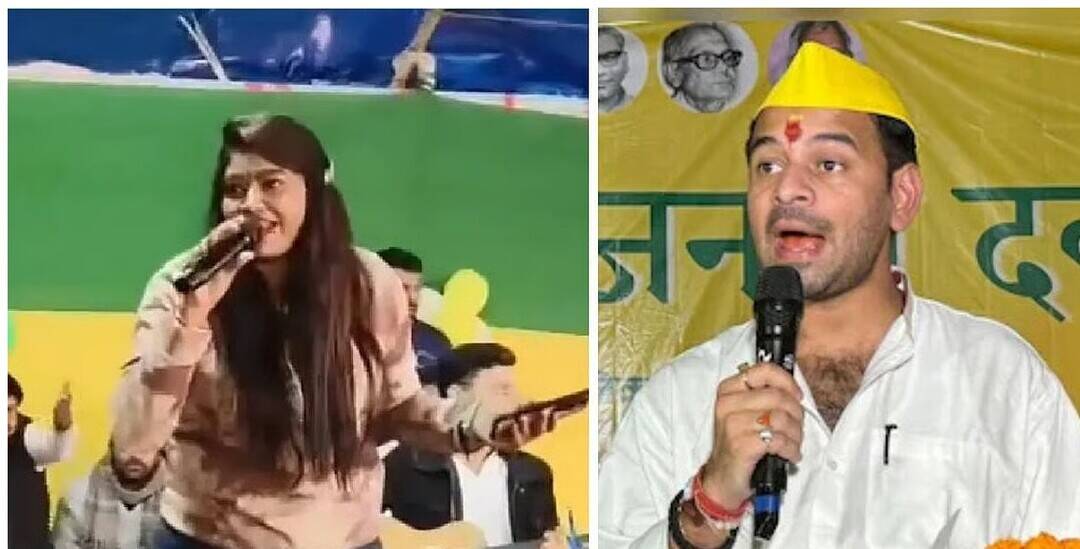
Tej Pratap asks singer to not sing ‘vulgar’ songs at Patna event
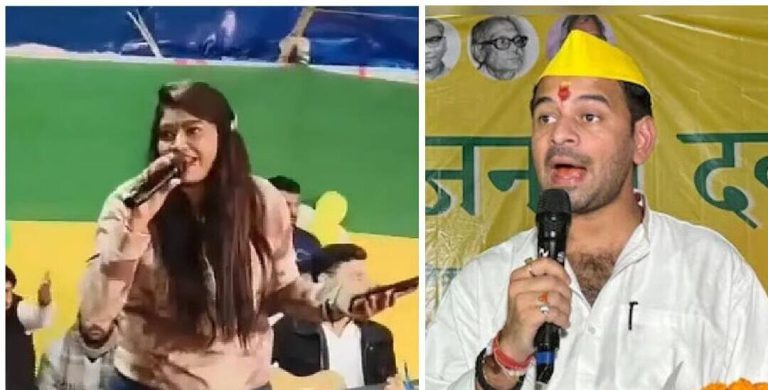
In a recent incident, Janata Jagran Dal (JJD) chief Tej Pratap Yadav made headlines by interrupting a Bhojpuri singer’s performance at a Makar Sankranti event in Patna. The video of the incident has gone viral on social media, sparking a debate about the role of politicians in dictating what kind of music is acceptable in public events.
The video shows Tej Pratap Yadav, who is also the son of former Bihar Chief Minister Lalu Prasad Yadav, walking onto the stage where the singer is performing. He is seen gesturing to the singer to stop singing, and then proceeds to address the audience. According to reports, Yadav told the singer to stop singing “vulgar” songs and instead sing devotional songs. “Krishna ji wala bhajan gaao (sing hymns of Lord Krishna),” he added.
The incident has sparked a mixed reaction on social media, with some people praising Yadav for taking a stand against “vulgar” music, while others have criticized him for trying to impose his personal values on others. Some have also pointed out that the singer was simply doing her job, and that Yadav’s actions were an overreach of his authority as a politician.
The debate surrounding the incident raises important questions about the role of politicians in shaping cultural norms and values. Should politicians have the power to dictate what kind of music is acceptable in public events? Or should they respect the freedom of artists to create and perform the kind of music they want?
On one hand, it can be argued that politicians have a responsibility to uphold certain standards of decency and respect for the cultural values of their constituents. If a significant number of people in the audience were offended by the singer’s performance, then it is reasonable for Yadav to intervene and ask her to stop.
On the other hand, the incident also highlights the dangers of moral policing and the imposition of personal values on others. What one person considers “vulgar” or “obscene” may not be the same for another person. By dictating what kind of music is acceptable, Yadav may be seen as trying to impose his own personal values on the audience, rather than respecting their individual freedom to choose what kind of music they want to listen to.
Furthermore, the incident also raises questions about the definition of “vulgar” music. Is it music that is explicit or suggestive in nature? Or is it music that challenges traditional social norms and values? If so, then who gets to decide what is “vulgar” and what is not?
The incident has also sparked a debate about the state of Bhojpuri music, which is a popular genre of music in Bihar and other parts of eastern India. Some people have argued that Bhojpuri music has become increasingly “vulgar” and “obscene” in recent years, with lyrics that objectify women and promote violence and misogyny.
However, others have pointed out that Bhojpuri music is a rich and diverse genre that reflects the cultural and social realities of the region. While some songs may be explicit or suggestive in nature, others may be devotional, romantic, or socially conscious. To label all Bhojpuri music as “vulgar” or “obscene” is to oversimplify the complexity and diversity of the genre.
In conclusion, the incident involving Tej Pratap Yadav and the Bhojpuri singer at the Patna event highlights the complexities and challenges of navigating cultural norms and values in a diverse and pluralistic society. While politicians may have a responsibility to uphold certain standards of decency and respect, they must also respect the freedom of artists to create and perform the kind of music they want.
Ultimately, the decision of what kind of music is acceptable in public events should be left to the audience, rather than being dictated by politicians or other self-appointed moral authorities. By respecting the diversity and complexity of musical genres, and promoting a culture of tolerance and inclusivity, we can create a more vibrant and dynamic cultural landscape that reflects the rich diversity of our society.
About the Author