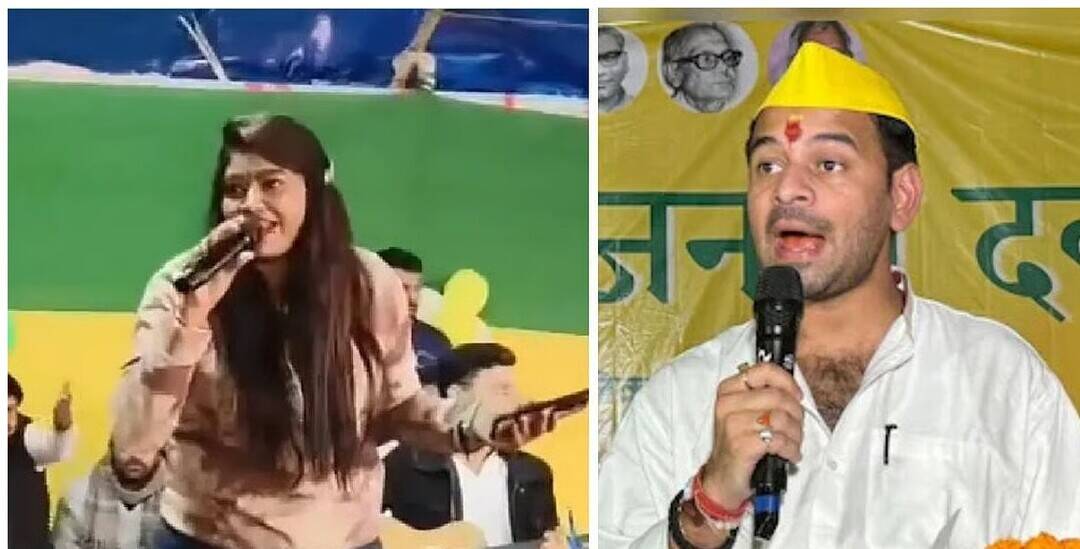
Tej Pratap asks singer to not sing ‘vulgar’ songs at Patna event
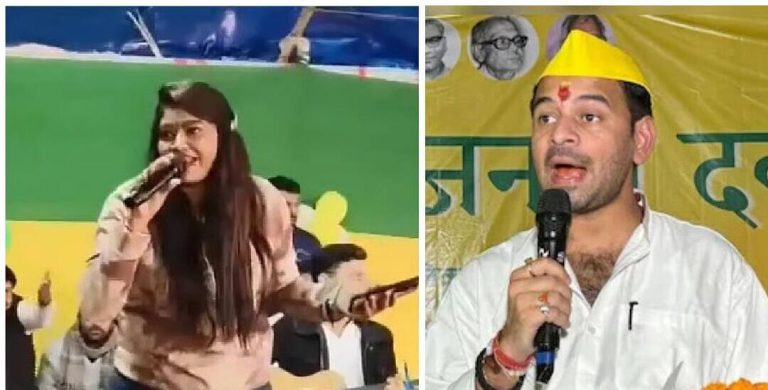
In a recent incident, a video has surfaced on social media where Jan Adhikar Party (JAP) chief Tej Pratap Yadav is seen interrupting a Bhojpuri singer’s performance at a Makar Sankranti event in Patna. The video, which has gone viral, shows Yadav taking the stage and asking the singer to stop singing “vulgar” songs, instead urging her to sing devotional songs.
The incident occurred during a cultural event organized to celebrate the festival of Makar Sankranti, which marks the beginning of the sun’s journey towards the northern hemisphere. The event, which was attended by a large crowd, featured a performance by a popular Bhojpuri singer. However, just as the singer was getting into her groove, Yadav suddenly appeared on stage, much to the surprise of the audience.
In the video, Yadav can be heard telling the singer, “Vulgar gaana mat gaao, bhajan gaao” (Don’t sing vulgar songs, sing hymns). He further added, “Krishna ji wala bhajan gaao” (Sing hymns of Lord Krishna). The singer, taken aback by the sudden interruption, can be seen trying to explain herself, but Yadav remains firm in his request.
The audience, which had gathered to enjoy the performance, seemed divided in their reaction to Yadav’s intervention. While some people cheered and applauded his move, others seemed disappointed and frustrated by the sudden interruption. The singer, who had been performing with great enthusiasm and energy, was forced to stop mid-way and switch to a devotional song.
This incident has sparked a debate on social media, with people expressing mixed opinions on Yadav’s actions. Some have praised him for taking a stand against “vulgar” content, while others have criticized him for interfering with the singer’s performance and imposing his own values on others.
Yadav, who is the son of former Bihar Chief Minister Lalu Prasad Yadav, has been known for his vocal views on various issues, including culture and morality. In the past, he has spoken out against what he perceives as “vulgar” content in Bhojpuri songs and films, arguing that they have a corrupting influence on society.
While Yadav’s intentions may be noble, his actions have raised questions about the role of politicians in shaping cultural norms and values. Should politicians be interfering with artistic expressions, or should they focus on more pressing issues that affect the lives of citizens? The incident has also highlighted the need for a nuanced discussion on what constitutes “vulgar” content and who gets to decide what is acceptable and what is not.
In a democratic society, artists and performers should have the freedom to express themselves without fear of censorship or interruption. At the same time, there is a need for sensitivity and respect for diverse cultural values and norms. As the debate rages on, it remains to be seen how this incident will impact the cultural landscape of Bihar and the role of politicians in shaping public discourse.
In conclusion, the incident involving Tej Pratap Yadav and the Bhojpuri singer has sparked an important conversation about the intersection of culture, politics, and morality. While Yadav’s actions may have been well-intentioned, they have raised questions about the limits of political intervention in artistic expressions. As we move forward, it is essential to engage in a nuanced and respectful discussion about what constitutes “vulgar” content and how we can promote a culture of respect, inclusivity, and diversity.
About the Author